
0.7.8: every card gets somewhere to stand

Every card in the game has somewhere to stand now. The picture behind a card's art was a recoloured template: a banner on a pole for the powers, a chevron ridge for the spells, two flat bands for the summons, the same three shapes in twenty palettes. This build cuts a place for every one of them from paper. Each pack gets a world of its own, drawn three ways. Each warlord's starter cards get the ground they were raised on. The cards that belong to nobody get one field drawn three times, every curse stands in the same bog, and fifteen borderless cards are cut from paper instead of drawn flat. Most of this post is pictures of that, old beside new. After the cards: the back wall of the arena is a picture for twenty-nine more fights, Motley Jack walks the road the Brass Pilgrim used to, and there is a new event in which you roll a real twenty-sided die.
Every card backdrop is cut paper now
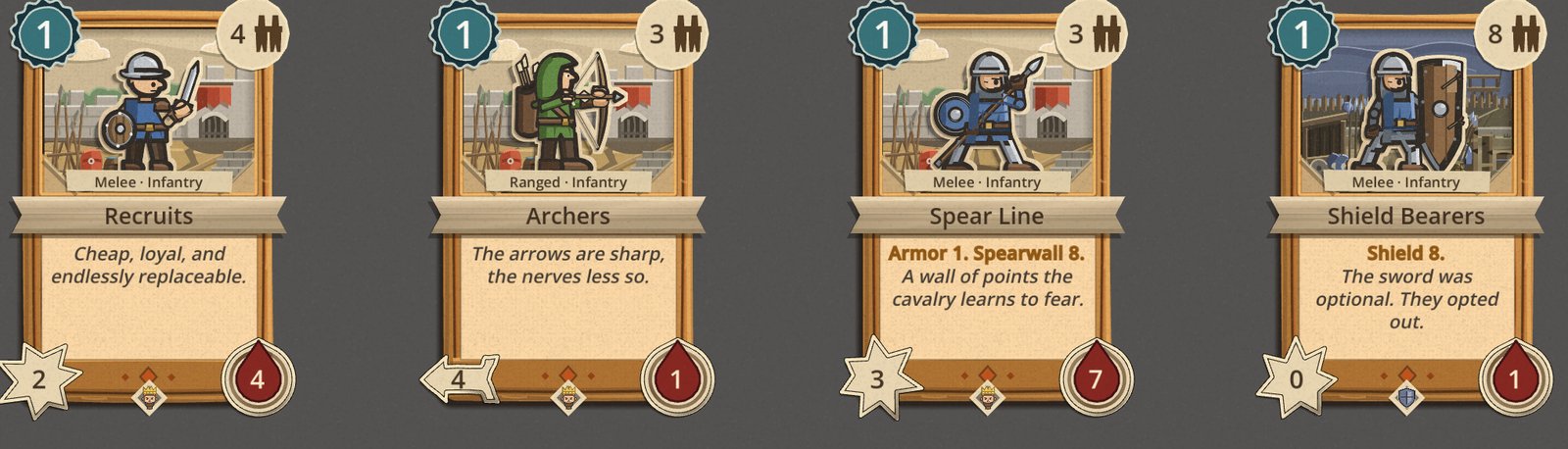
Start with the cards you draw on turn one. The King's Recruits, Archers and Spear Line used to stand in front of a flat curtain wall with two banners on it. They stand in his muster yard now, inside his own wall, in the morning, with the practice stakes and the kit laid out.
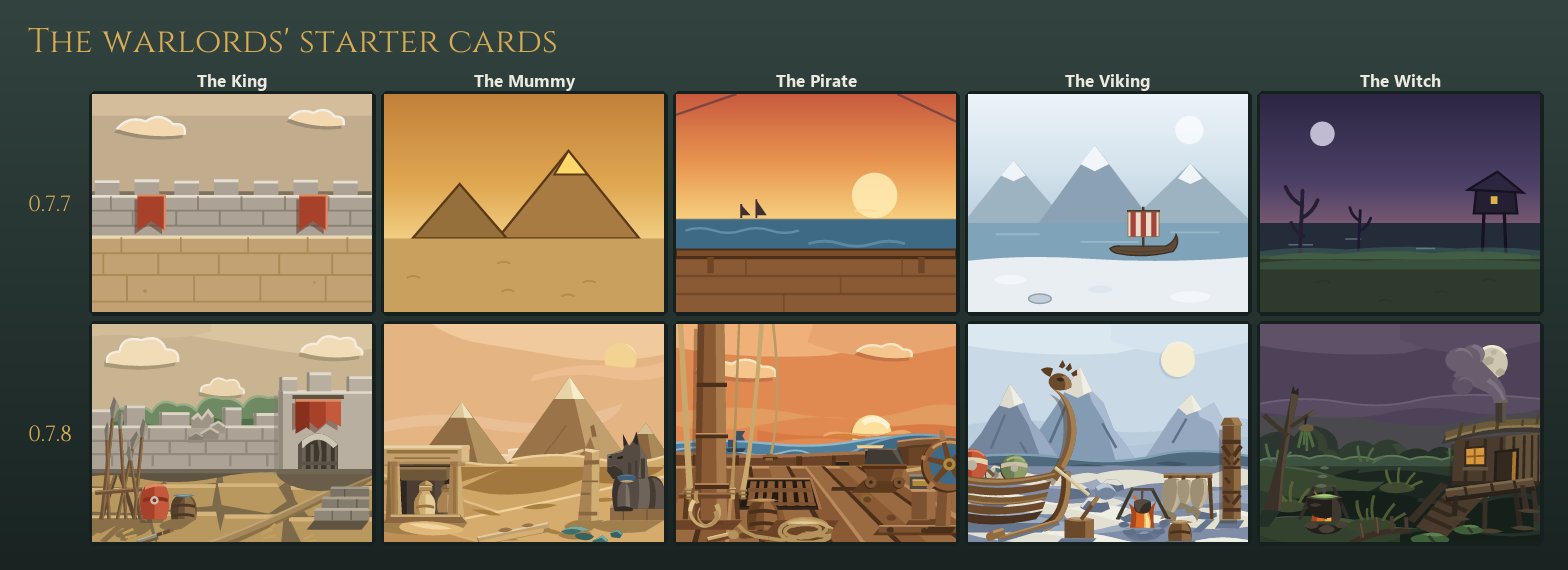
Every warlord got the same treatment. On each board below the top row is what 0.7.7 put behind that warlord's starter cards and the bottom row is what 0.7.8 does. The Mummy's necropolis is the tomb mouth in hard desert light, with the jackal at the door. The Pirate's deck is her own, the sun going down over the swell, wheel and rope and a barrel of the good stuff. The Viking's shore is the shingle at the head of a fjord with the longship drawn up on it and the fire lit, and the Witch's fen is the deep swamp at dusk with her hut standing in it on its legs, one window lit.
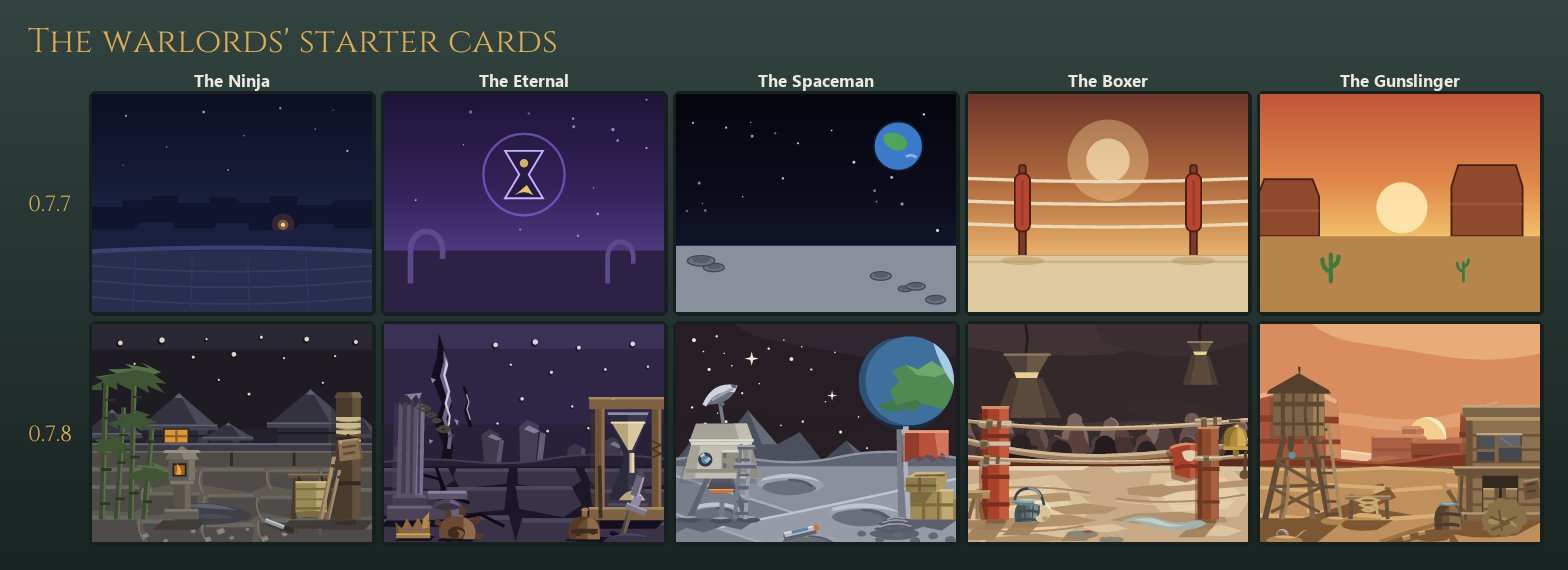
The Ninja's courtyard has no moon on purpose: the only light on the sheet is the temple lanterns. The Eternal's field is several eras standing in the same ground under a violet night, a standing stone and a broken column and a rusting engine in one field. The Spaceman gets grey regolith on an airless world with the planet he claimed hanging over it. The Boxer gets the ring under the hall lamps, and the Gunslinger the head of a frontier town on red hardpan with the sun nearly down.
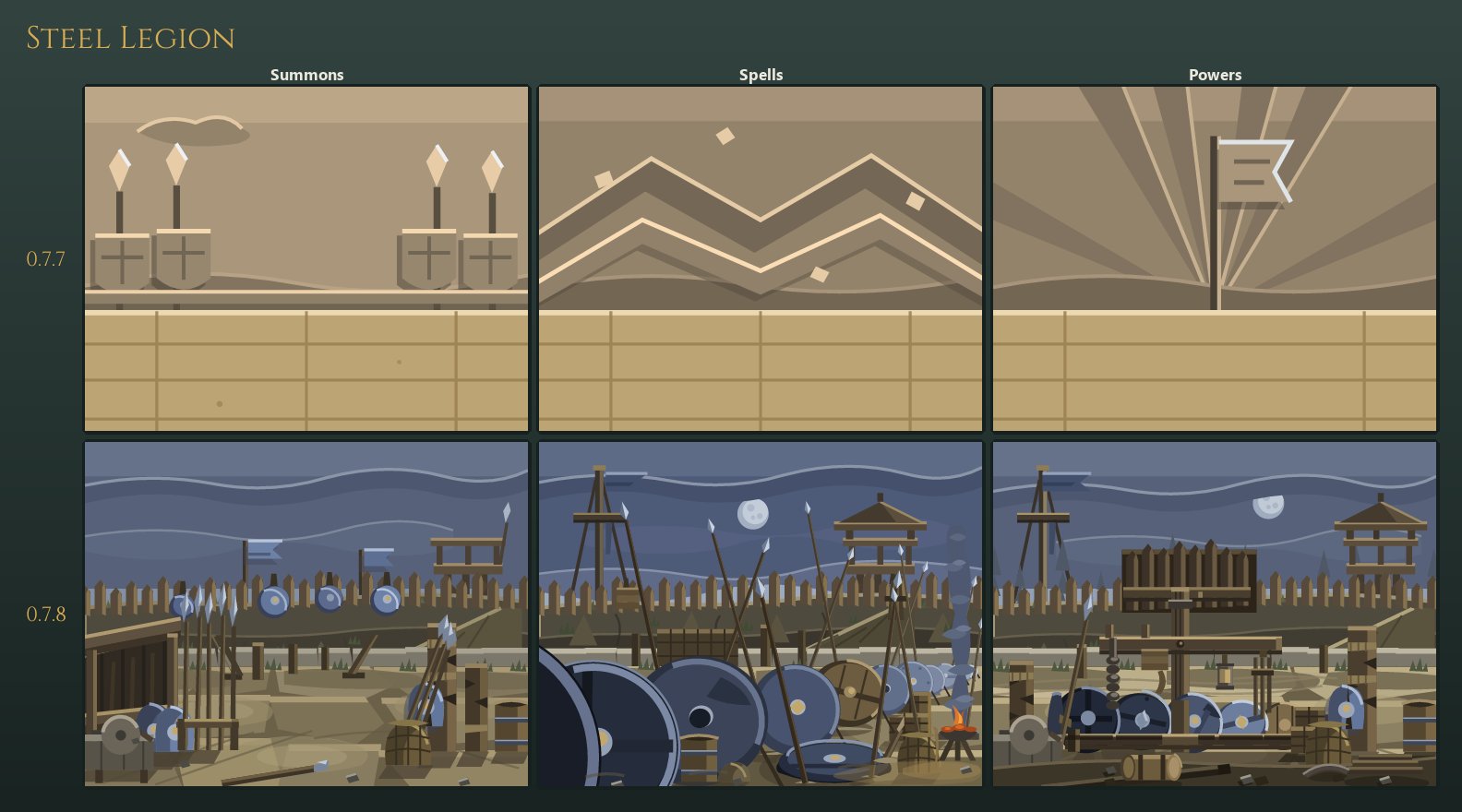
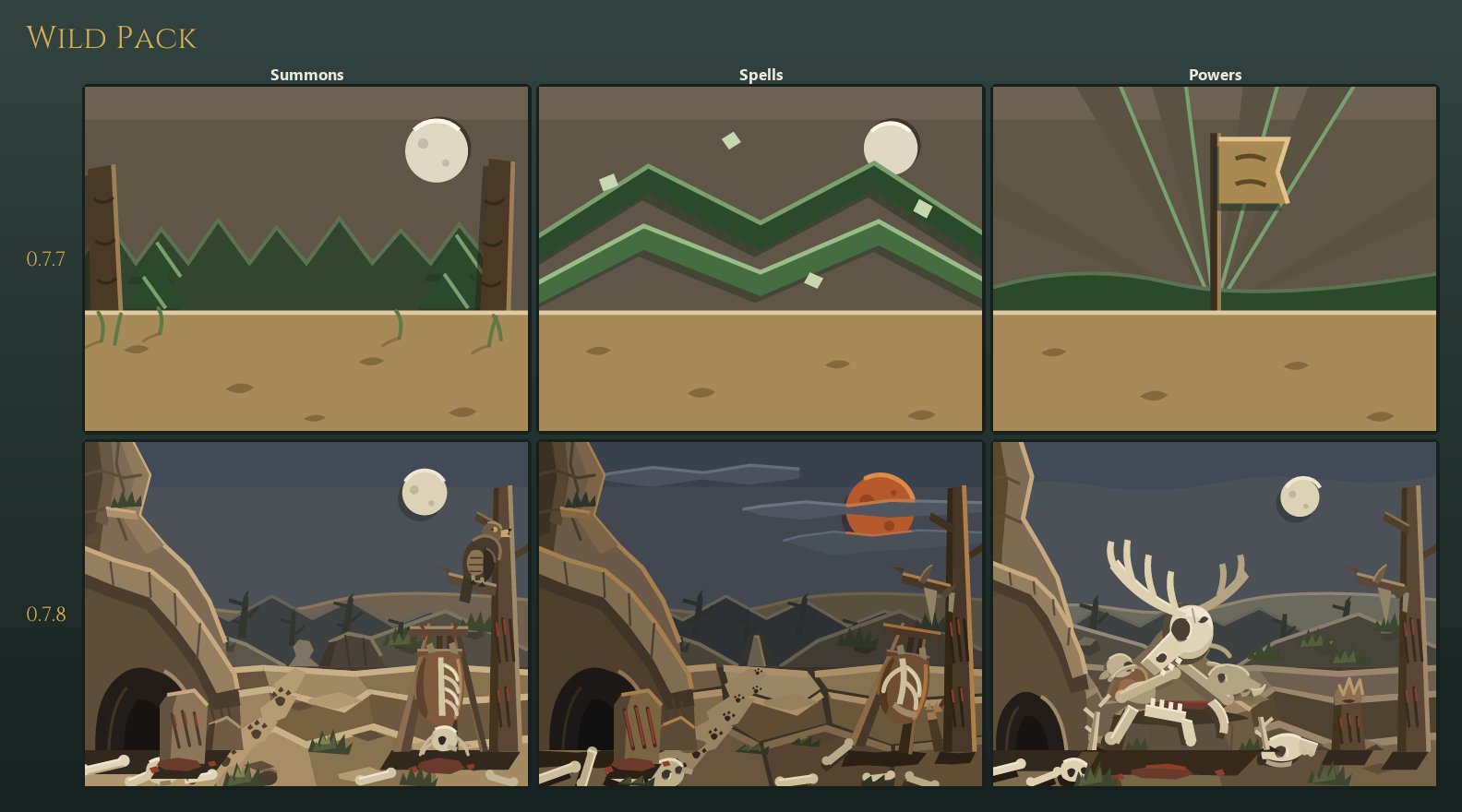
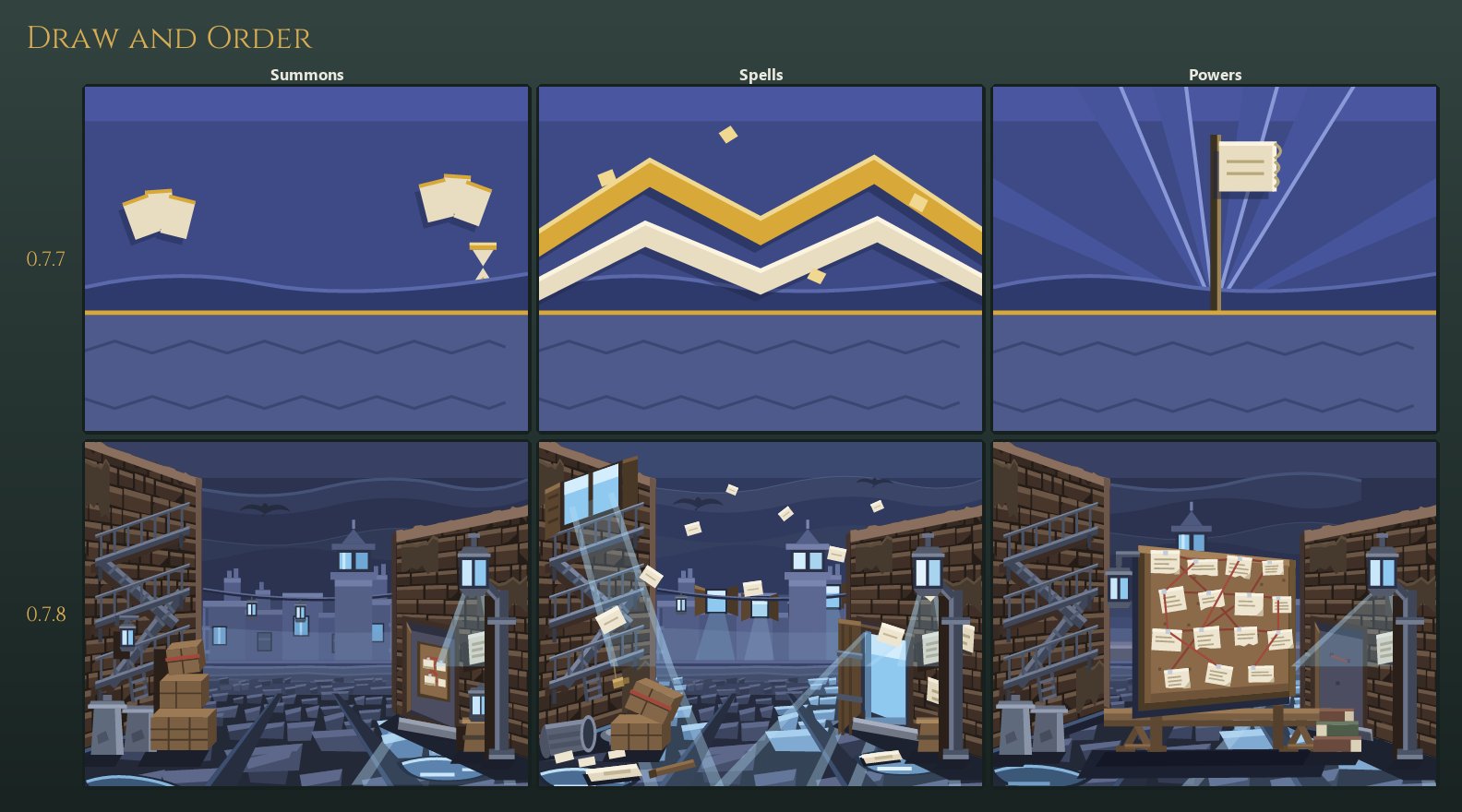
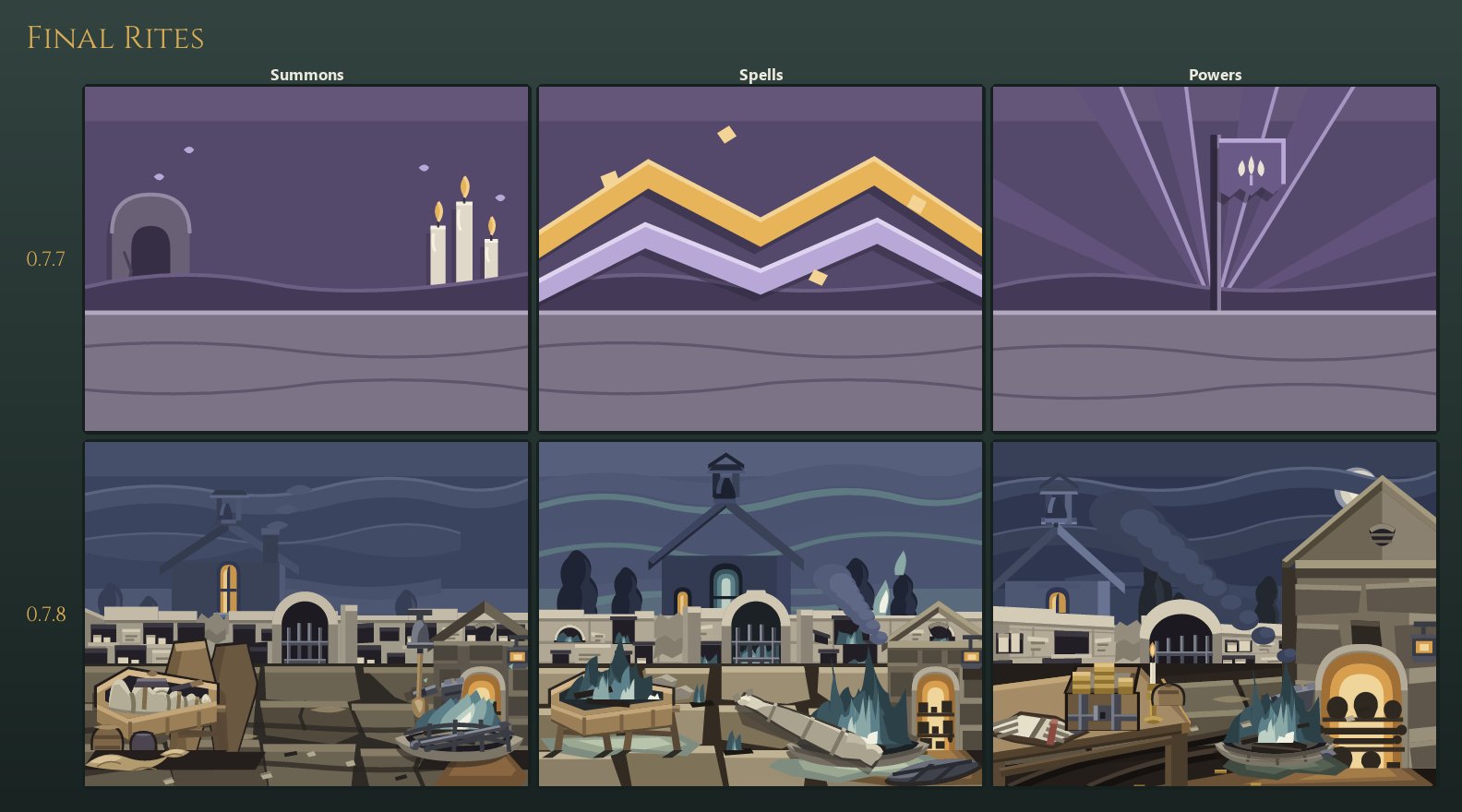
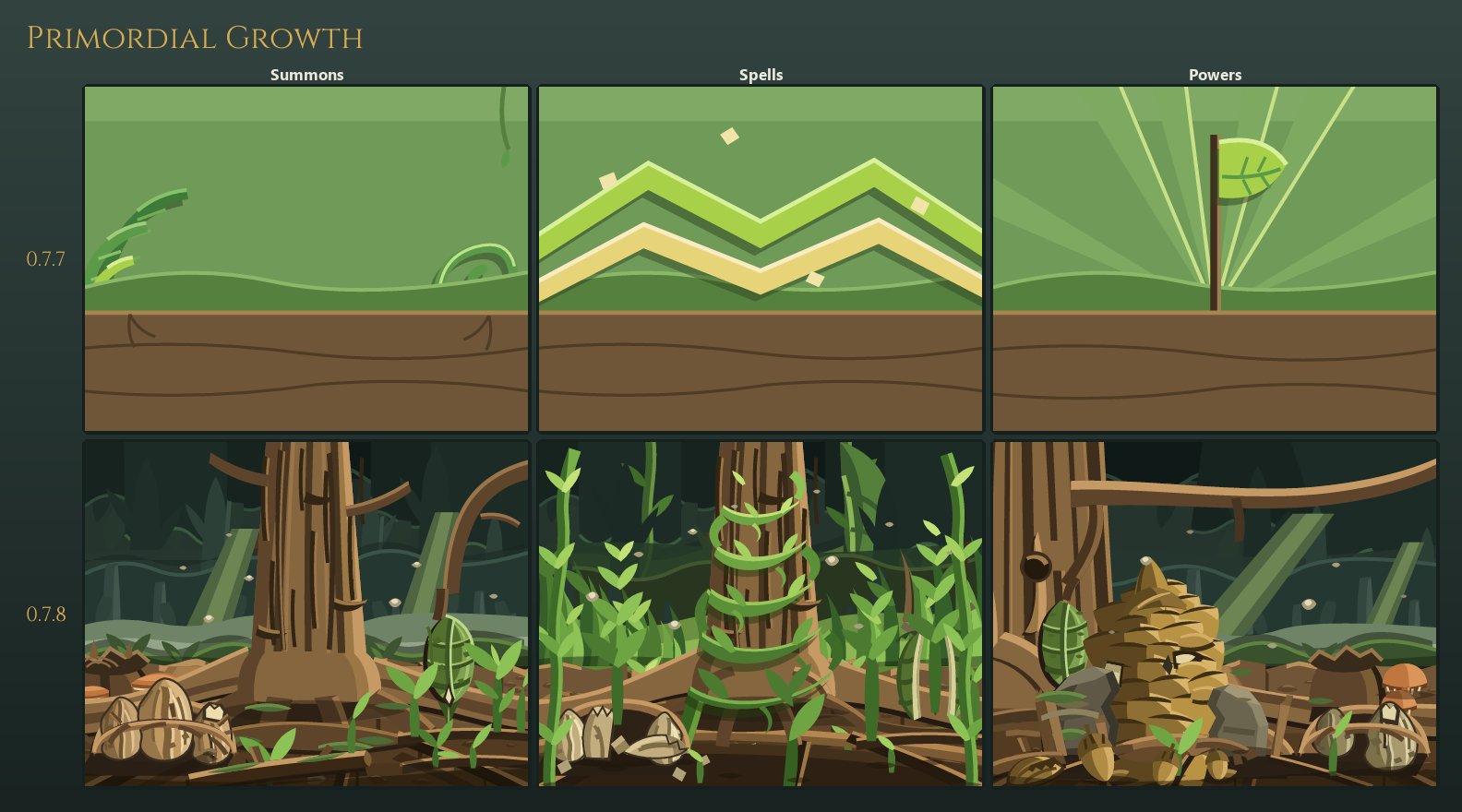
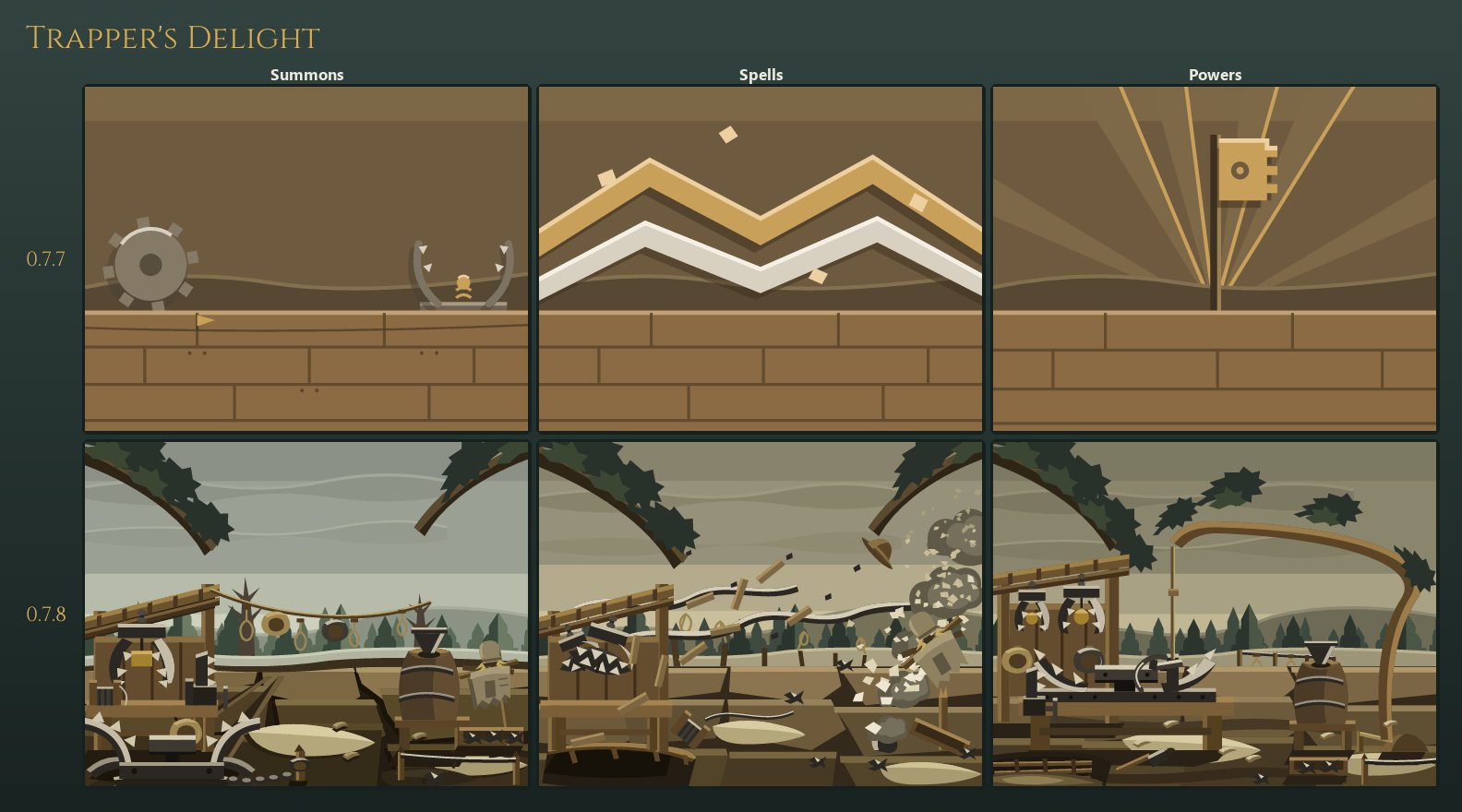
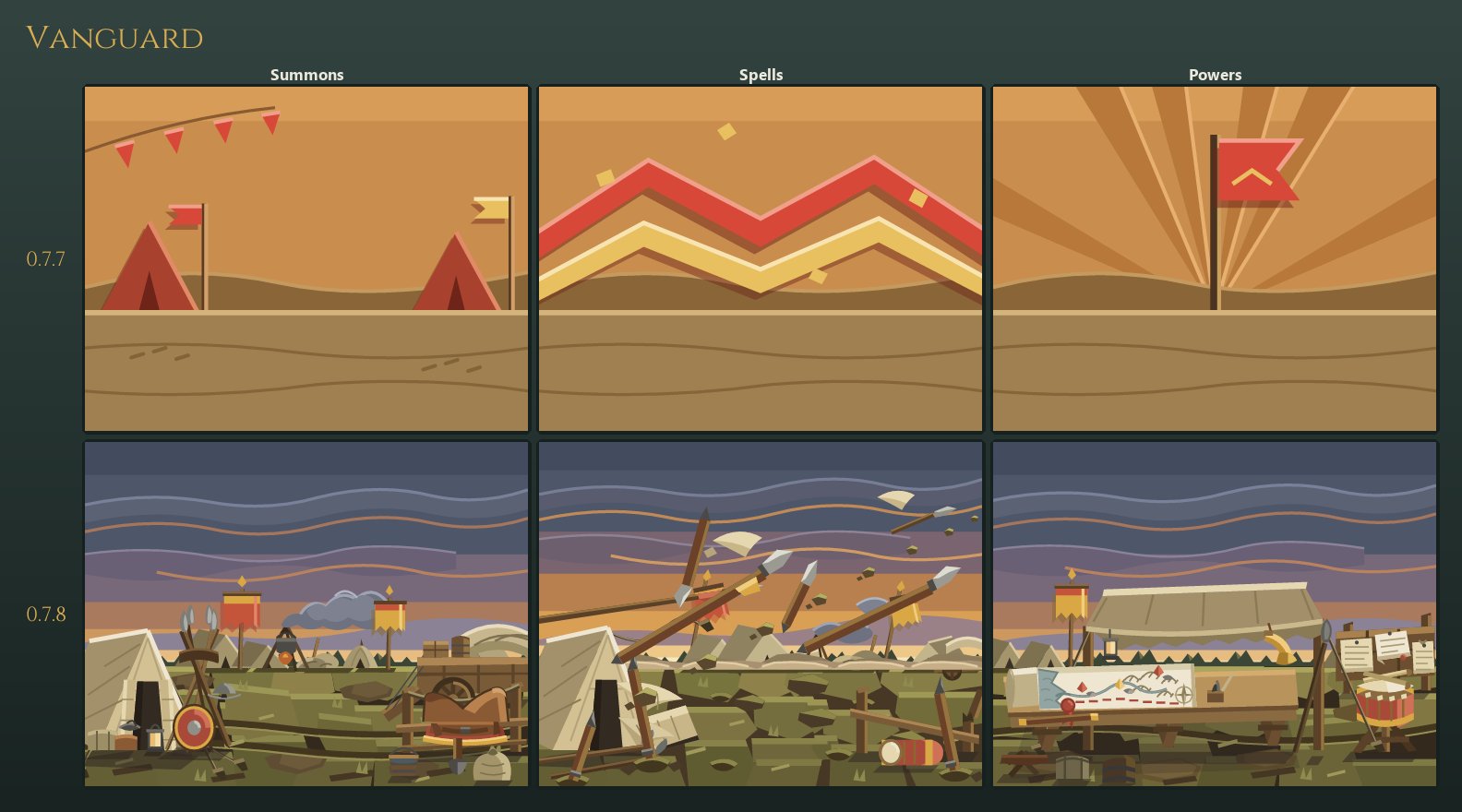
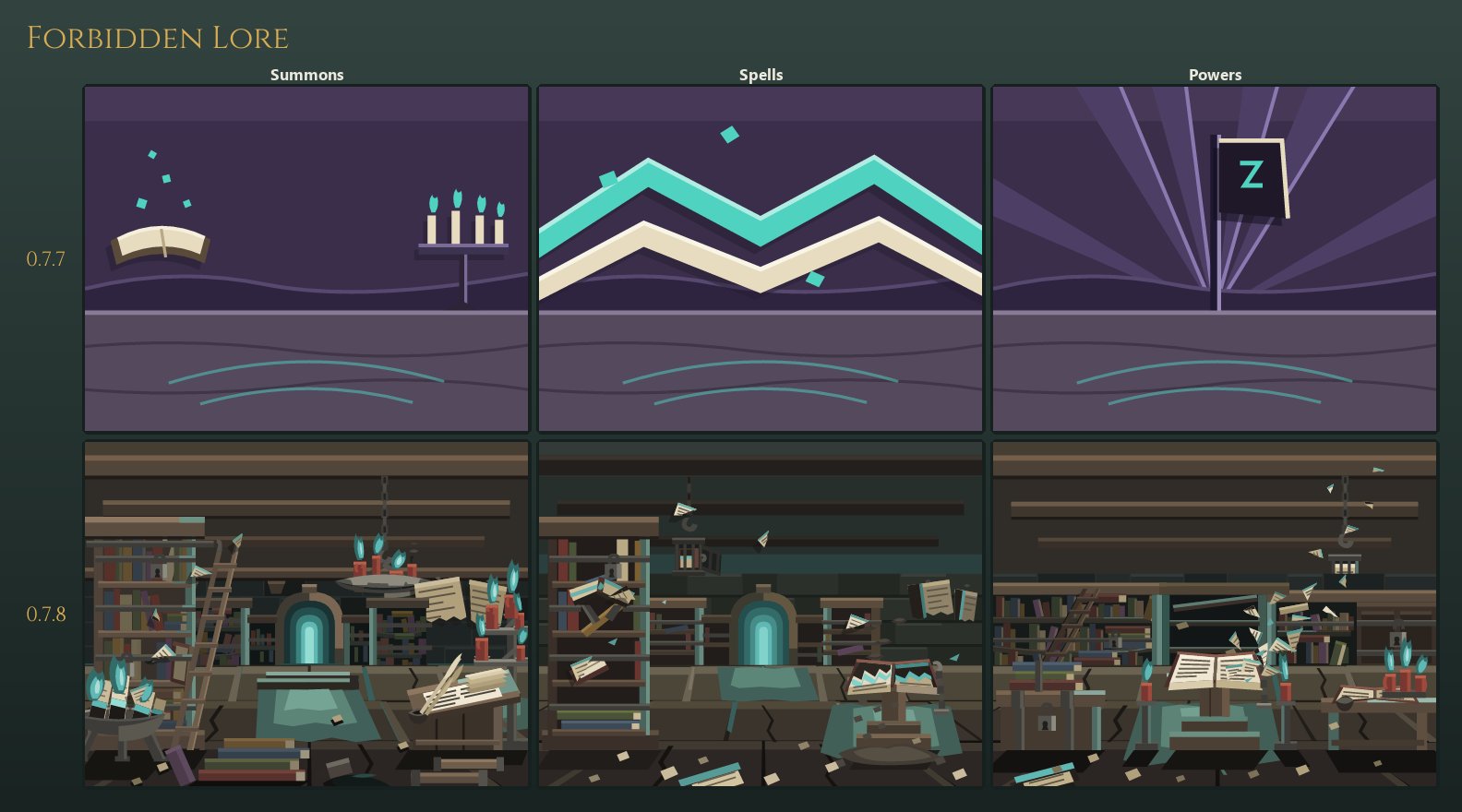
Now the packs. Each of the twenty got one place, and that place is drawn three times: at rest for the summons, at the thing the pack is built around for the powers, and mid-surge for the spells. Each board below is one pack, the three scenes across, 0.7.7 above and 0.7.8 below.
Steel Legion stands in Coldmuster, the drill yard dug in behind the rampart at the grey hour before the muster is called. The powers are taken up at the muster stand at the end of the yard. The spells are the same yard with the wall locked.
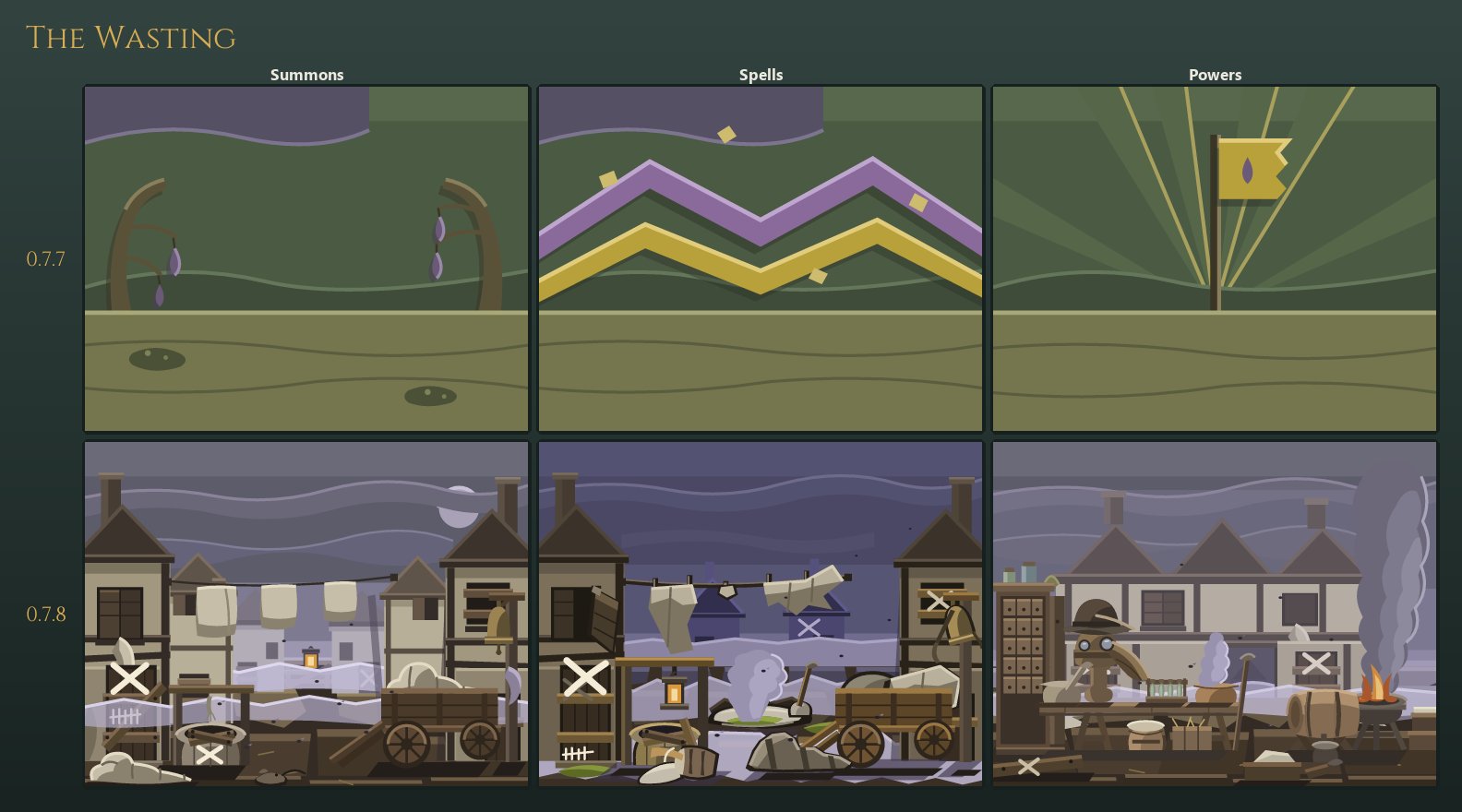
The Wasting is Chalk Street, the sealed row of a lazar-town where nobody has come out for eleven days. The powers are drawn at the vinegar table the plague doctor keeps set up in the middle of the row. The spells are the moment the sickness lets go, the fog lying wide and shallow along the street.
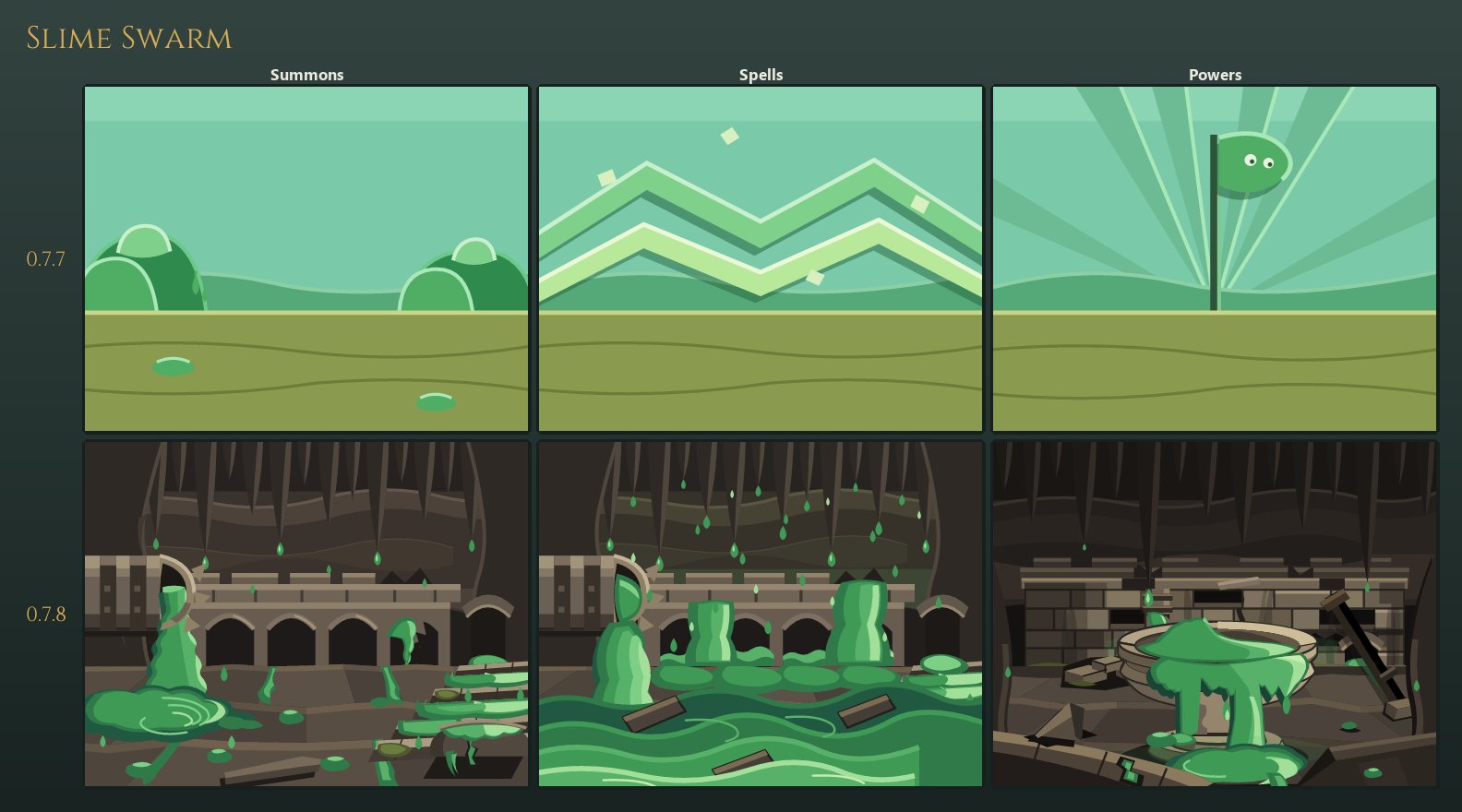
Slime Swarm has the Ninth Arch Sump, the flooded cavern under the broken aqueduct where the water stopped being water. Powers come off the Drawing Font at the cistern. Spells are the sump in flood, the cavern filling.
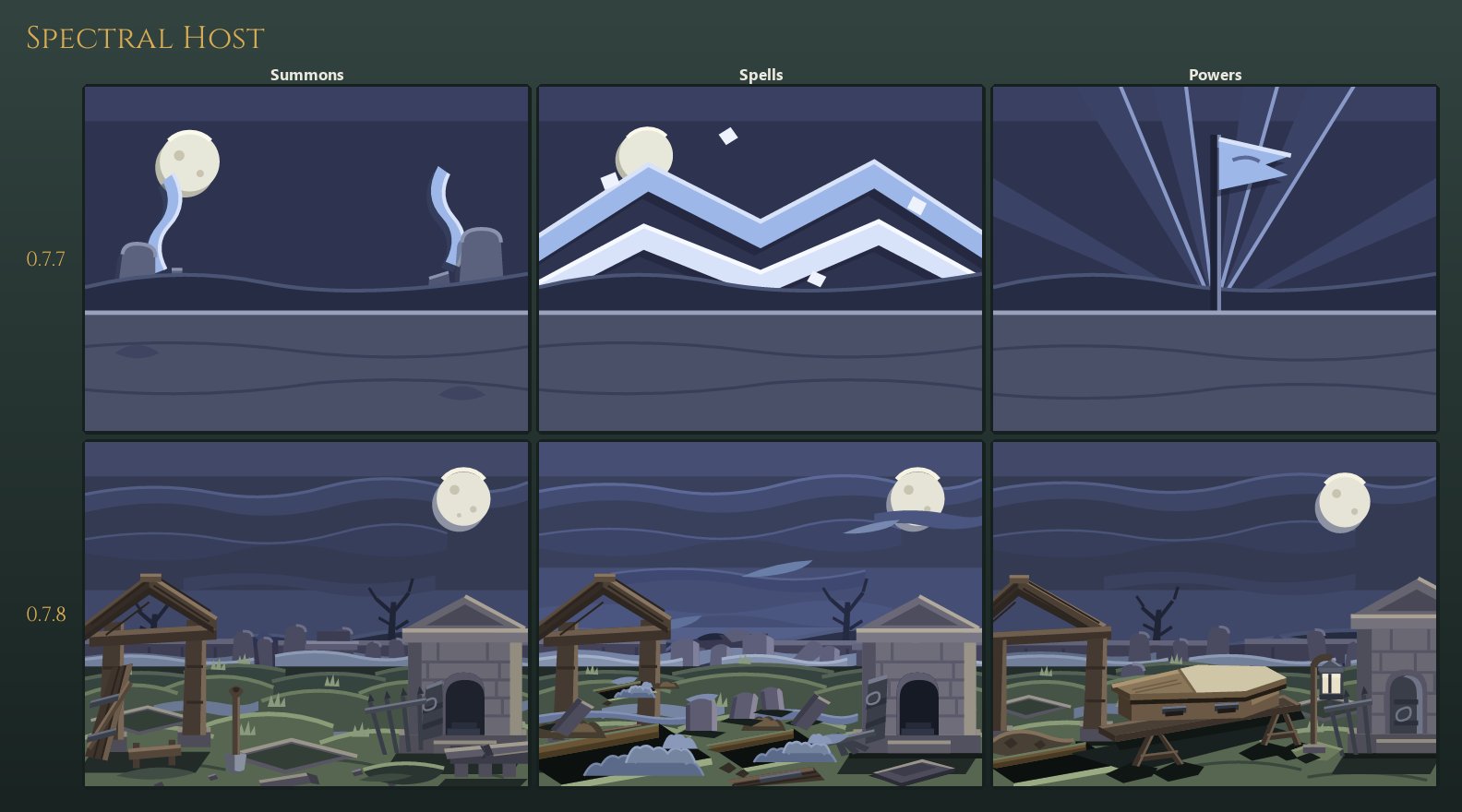
Spectral Host stands in Hollowmere Yard, the burying ground whose gate was broken open one winter and never mended. The powers are lifted off the dead at the bier end. The spell scene has nobody in it at all, only the ground given up.
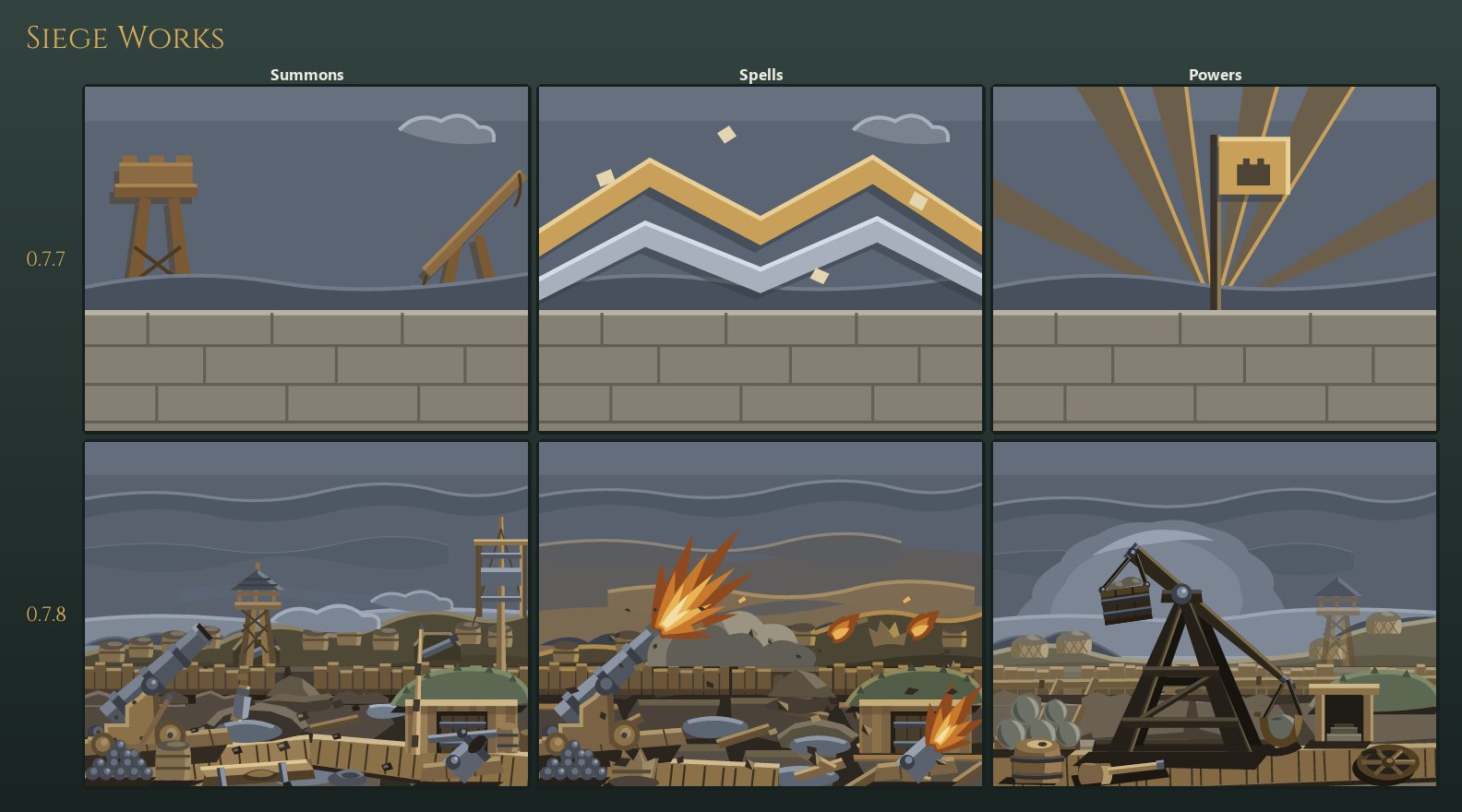
Siege Works is Longshot Battery, the gun pit dug in behind an earthwork, seen from inside the works looking out over the parapet. The powers are the great sling stood alone in the middle of the pit. The spells are the whole line going off together.
Wild Pack has the Bone Gully, the den at the head of the scree where the pack sleeps a kill off. The powers are the kill-stone, the broad low boulder everything gets dragged back to. The spells are the night the hunt goes out under a blood moon, and nothing alive is drawn: the hunt is told by what it left.
Goblin Horde stands on the Muckstack, the shanty warren the horde has piled up the side of a spoil hill, at rest before the shout goes up. The powers are the muster ring at the foot of it. The spells are the warren emptying itself down the hill the moment the drum goes.
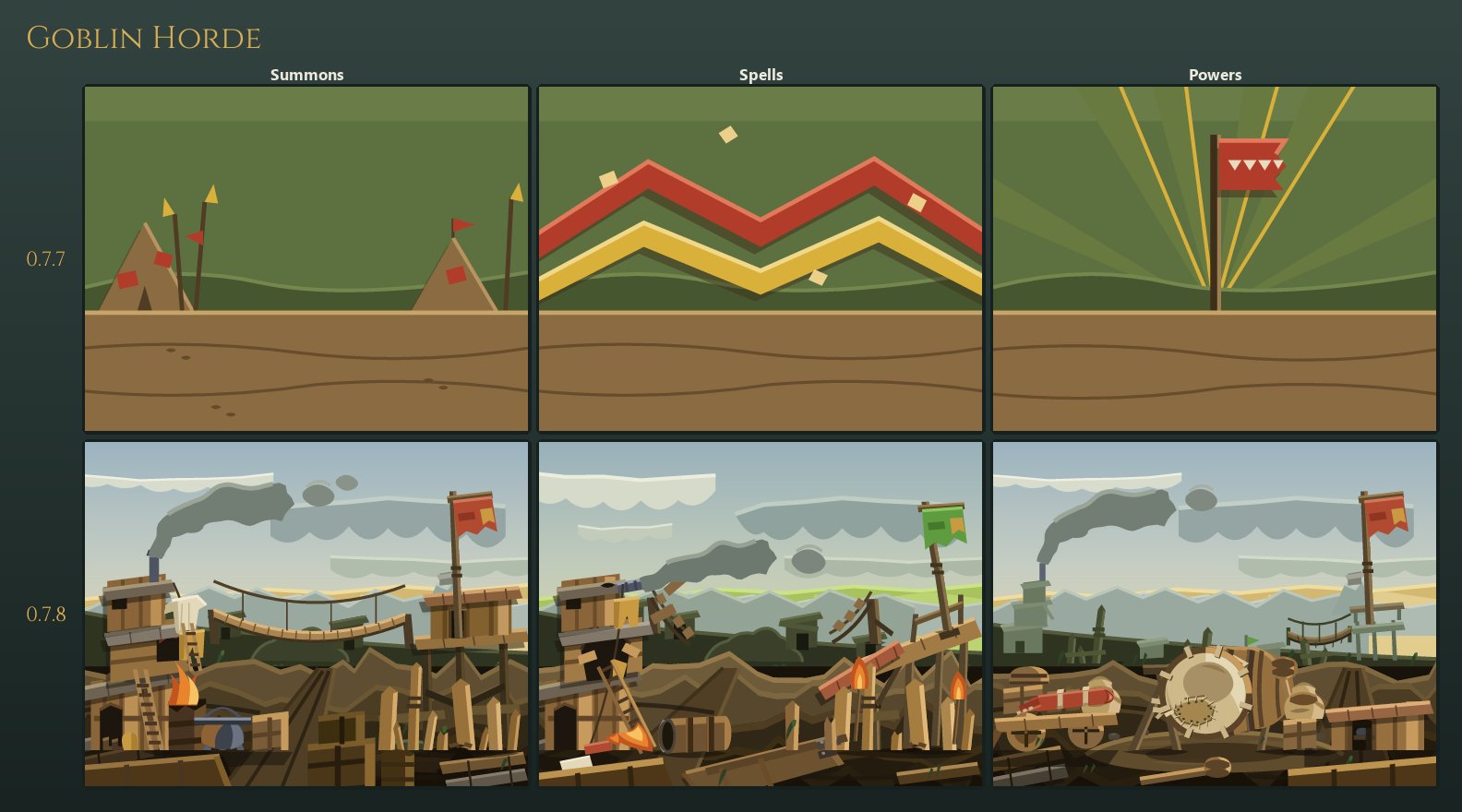
On the cards themselves. Pack Wolves, Thick Fur and Blood Moon on the left are the three Wild Pack scenes; Goblin Archers, Goblin Drum and Conscription on the right are the three Goblin Horde ones.

Draw and Order is Whistle Lane, the wet back alley behind the Fourth Watch-house, where the night shift keeps its bins, its crates and its evidence. The powers are the lead board the squad has dragged out into the alley. The spells are mid-raid, the whole shift coming out of the doors at once.
Final Rites is the Reckoning Yard, the undertakers' working yard behind the funerary chapel at dusk. It is a trade, not a haunting: coffins on trestles, the cart, the ledger. The powers are settled at the tithe table at the far end. The spells are mid-rite, the offering pit paid.
Primordial Growth has the Broodroot, the hatchery grove held in the buttress roots of one enormous tree, where everything on the floor is either an egg or about to be. The powers are the seed vault at the far end of the grove. The spells are the whole hatchery coming up at once.
Trapper's Delight is the Snare Line, the working clearing at the head of a trapline, and the near foreground belongs to one bear trap. The powers are the trigger bench, the low table in the middle of the clearing where a trap is set. The spells are the instant the whole clearing goes off.
Vanguard is the Marchfield, the muster ground at first light, struck and standing ready to move off. The powers are taken up at the muster table. The spells are the instant the order goes, the camp still standing behind the column that has already left it.
Overgrowth stands in the Broodroot; Bear Traps, Switcheroo and Munitions on the Snare Line; Light Cavalry, Redeploy and Vanguard Charge on the Marchfield.

Forbidden Lore is the Chained Scriptorium, the locked end of a library where the books are belted shut and read anyway. The powers are copied at the lectern in the middle. The spells are a page spent that does not come back.
Behind You! is the Sparrow Walk, the guild's rooftop road over the sleeping quarter, three hours after the lamps went out. The powers are the drop-box, the guild's dead-letter cache. The spells are the job going off, the place unchanged and legible under it.
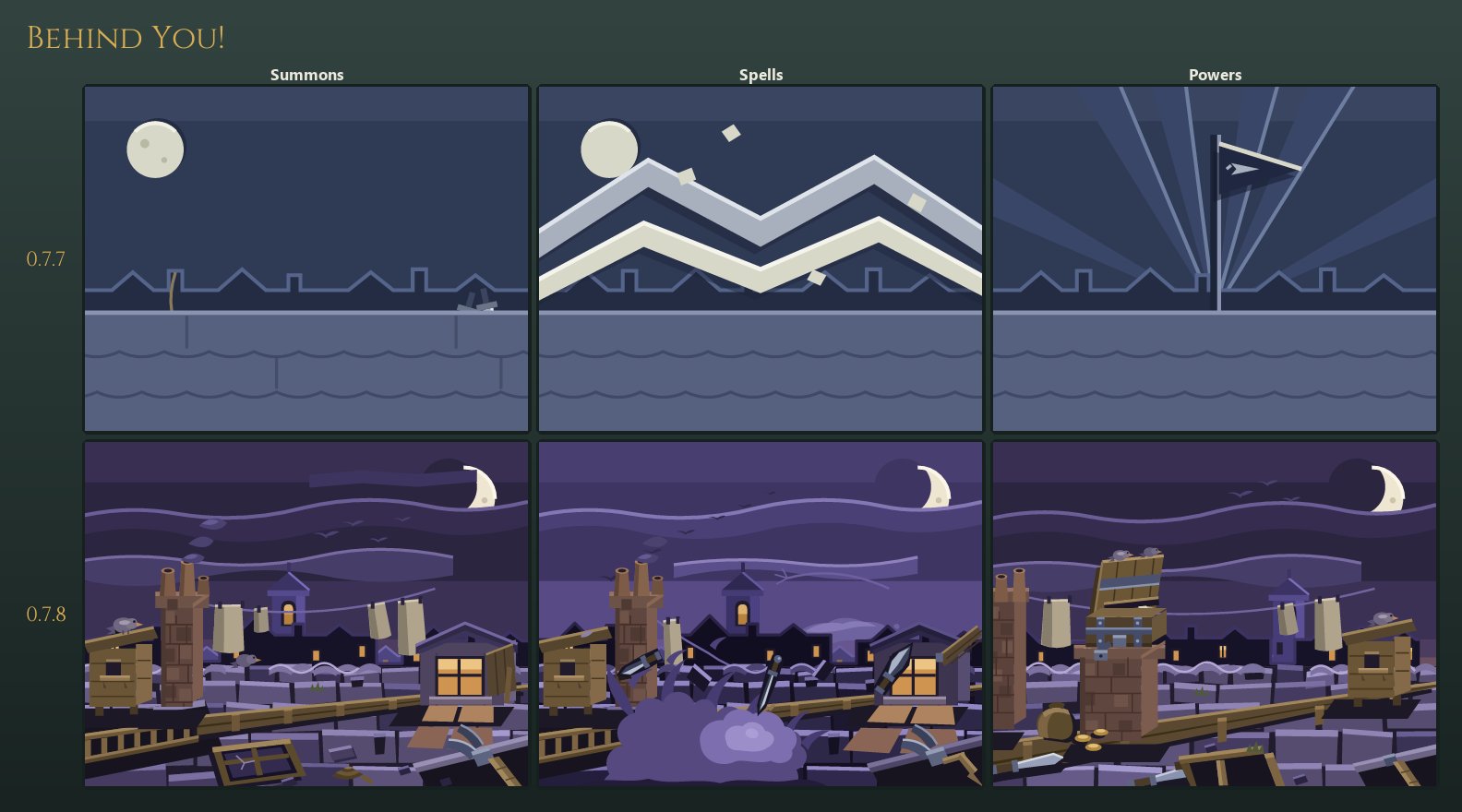
Errant Whispers, Read Aloud and Revelation in the scriptorium; Footpads, Fan of Knives and Cover of Night on the roofs.

Heartbreakers is Sweetbriar Terrace, the outside of the ballroom at the end of a long night. The powers are the letter table, the end of the terrace where the writing gets done. The spells are mid-charm, the whole garden coming apart and going over the house.
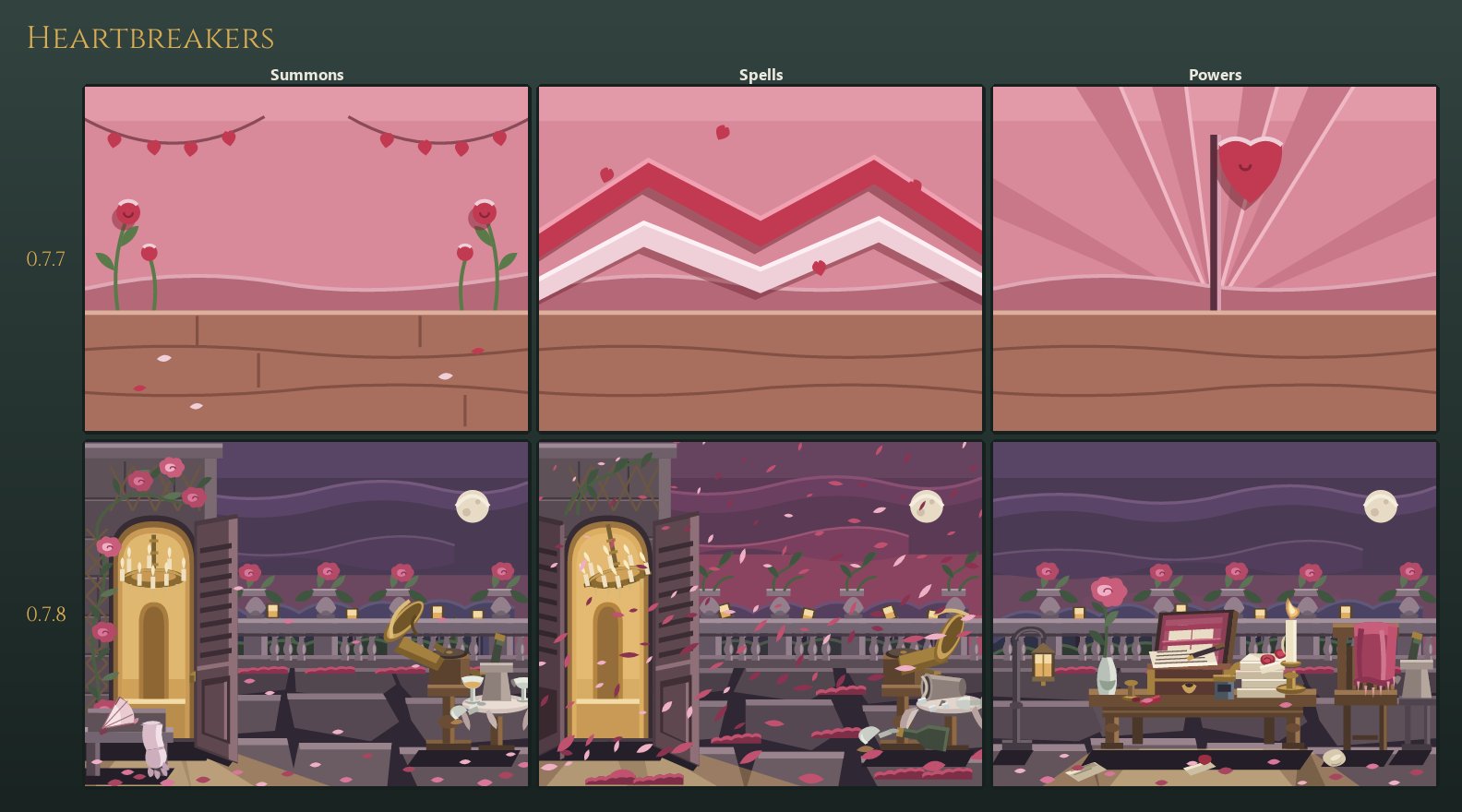
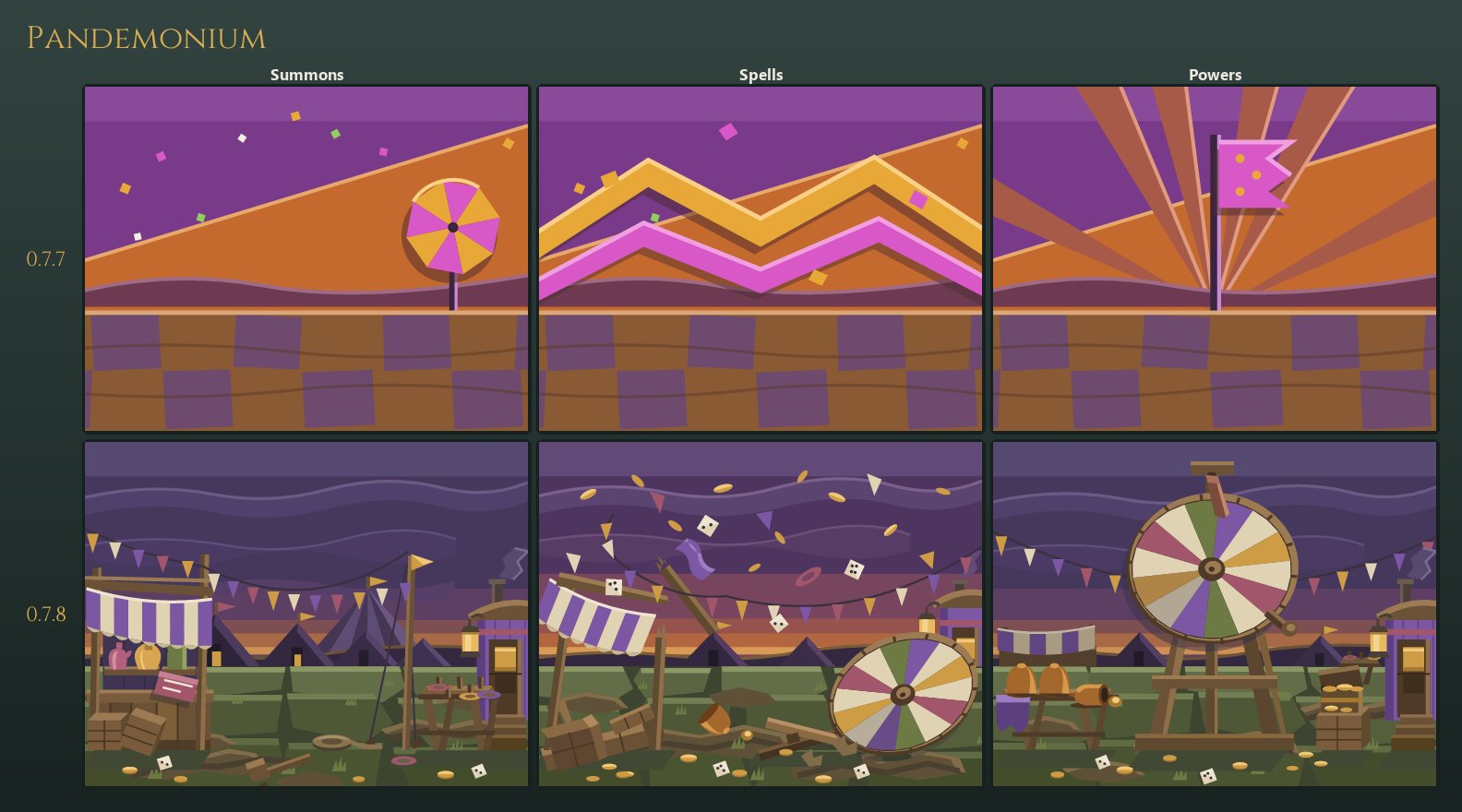
Pandemonium is the Crooked Row, the gambling end of a travelling fair after the crowd has gone, pitched on a slope so nothing on it is level. The powers are the prize wheel, the one thing on the row everybody queues for. The spells are the row going over.
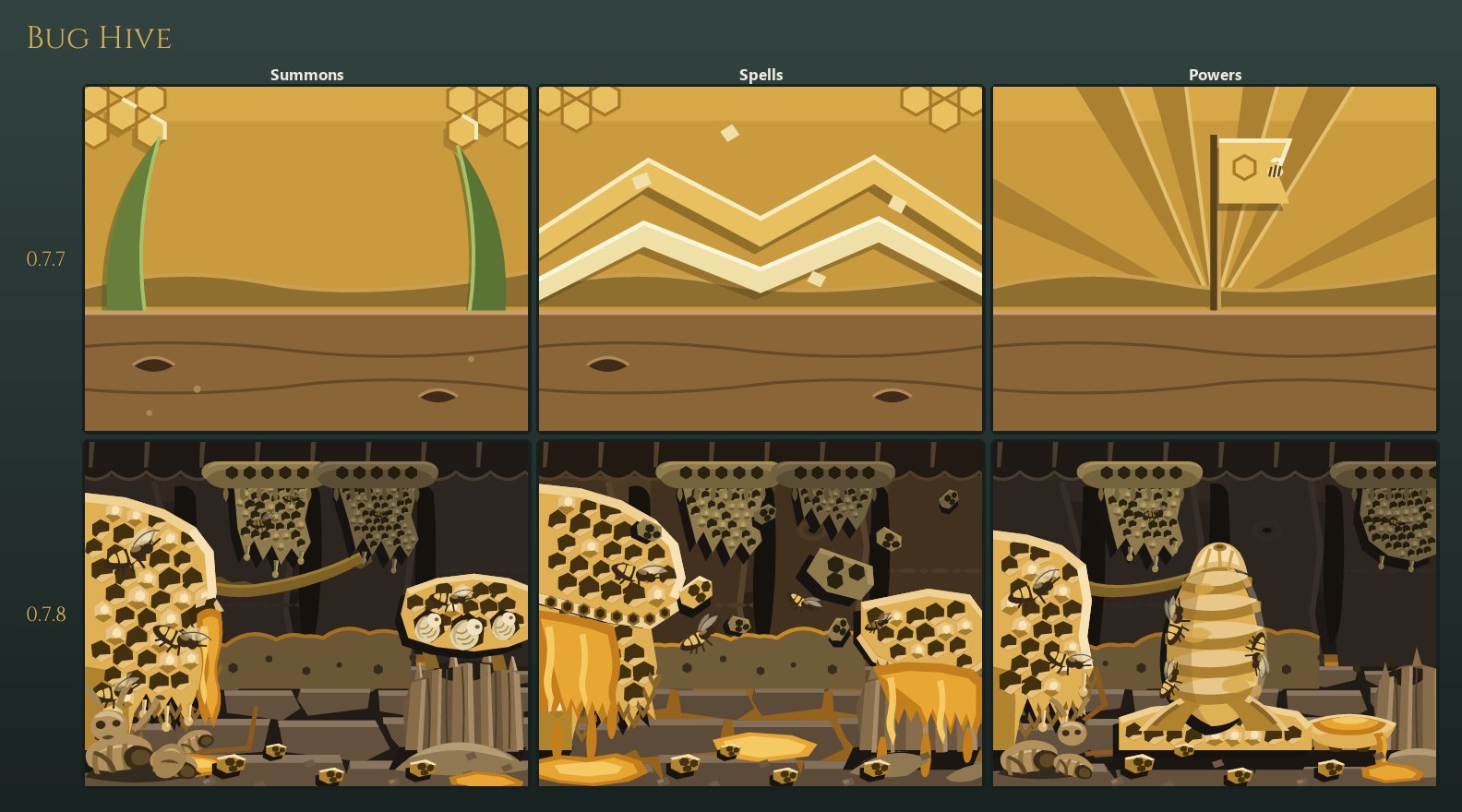
Bug Hive is the Wax Gallery, a room the swarm chewed out of a hollow trunk and then rebuilt in wax. The powers are the royal cell the whole hive is built around. The spells are the hive roused, the comb wall sheared open.
Mutagenesis is the Decanting Cellar, the vaulted undercroft where the growing vats are kept warm and nobody has mopped since the last one went over. The powers are the dosing end, where a dose is drawn and something goes past its limit. The spells are the vats going over.
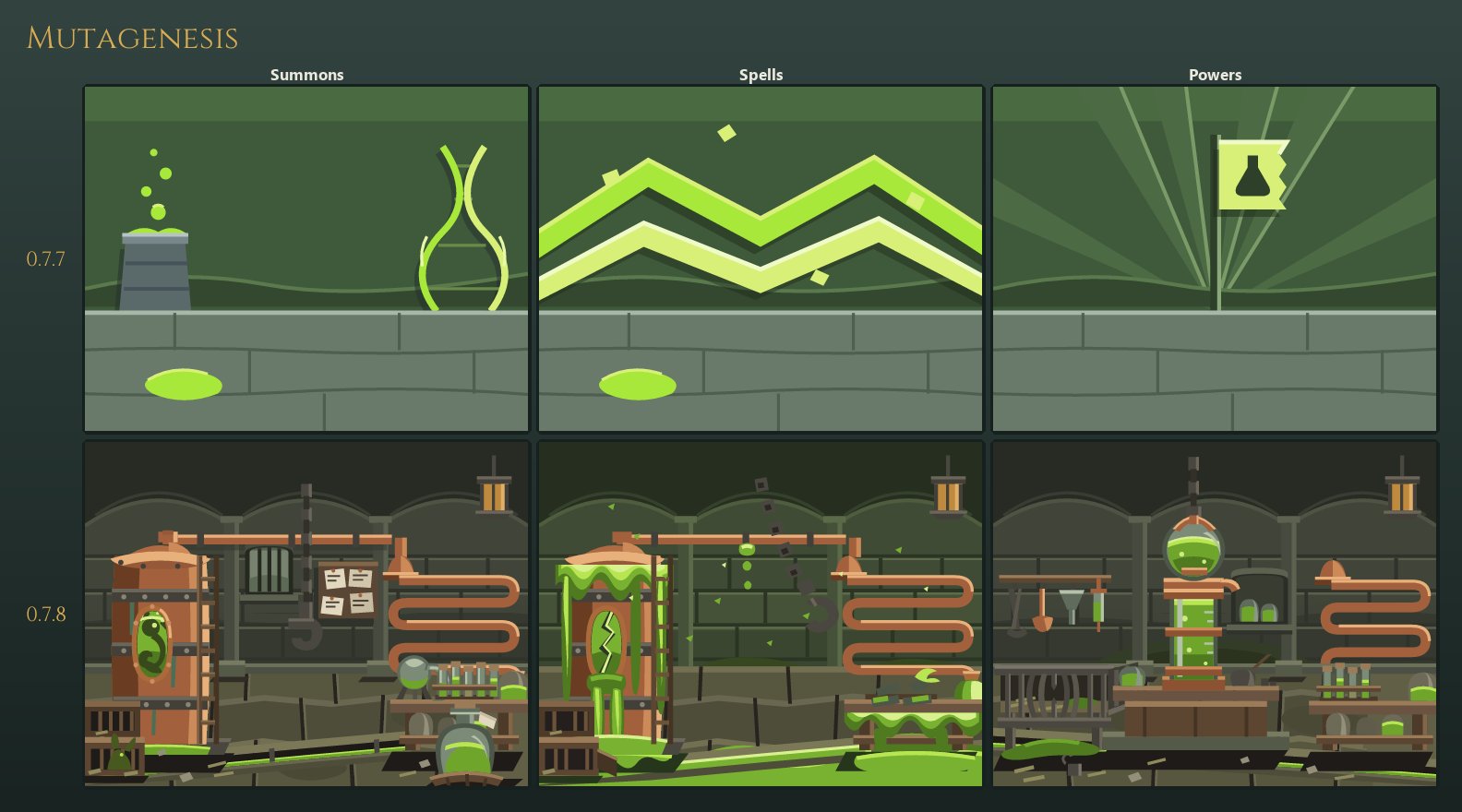
Giantkind is the High Shoulder, the camp giants keep on the mountain's shoulder, built throughout at the wrong scale for people. The powers are the mark-stone, the carved menhir the camp's oaths are taken at. The spells are the moment something the size of the mountain puts its weight down.
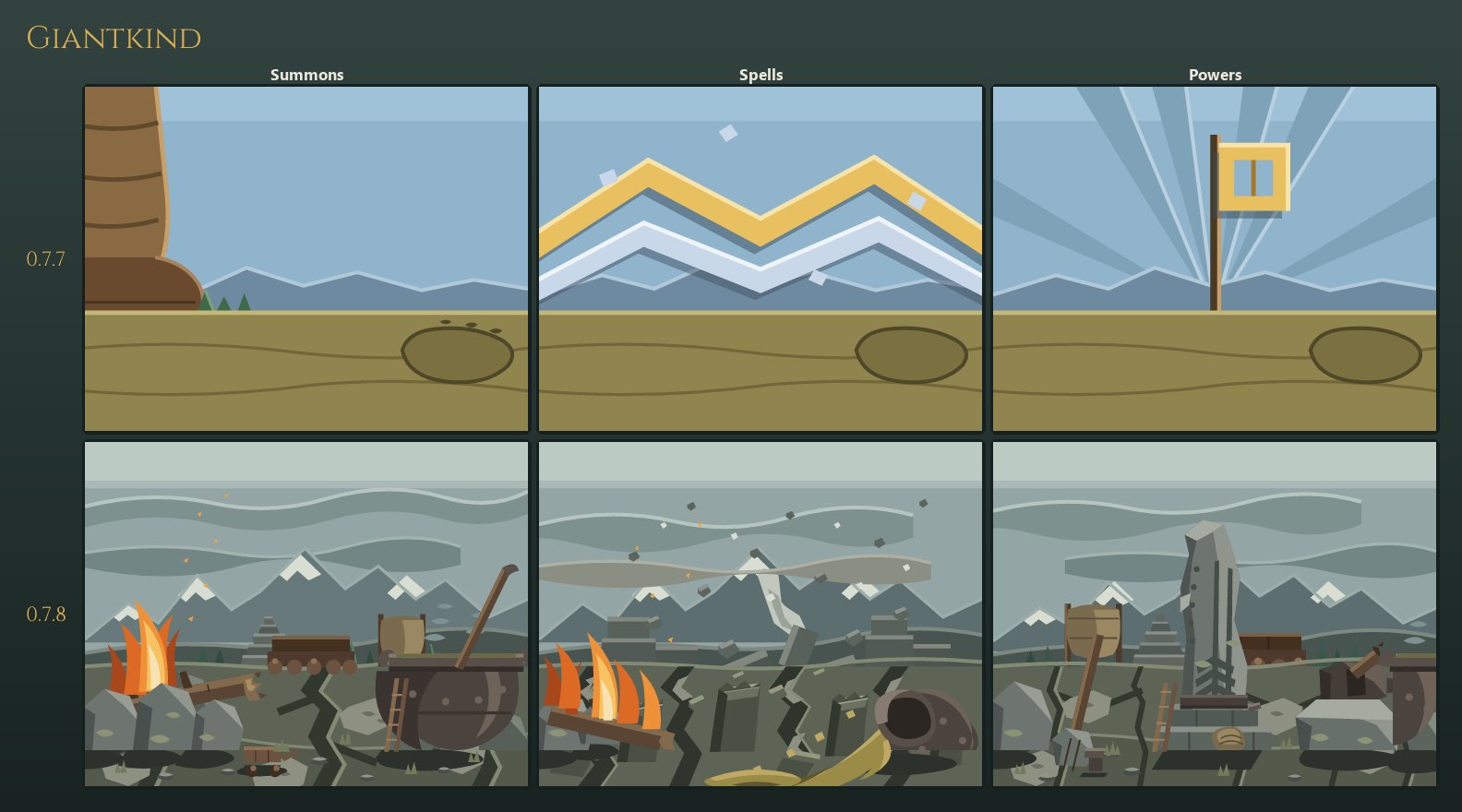
Test Subjects, Growth Serum and Hypertrophy in the cellar; Young Giant, Embiggen and Giant's Blood on the shoulder; and Uncontrolled Pupation, on the left, in the Wax Gallery.

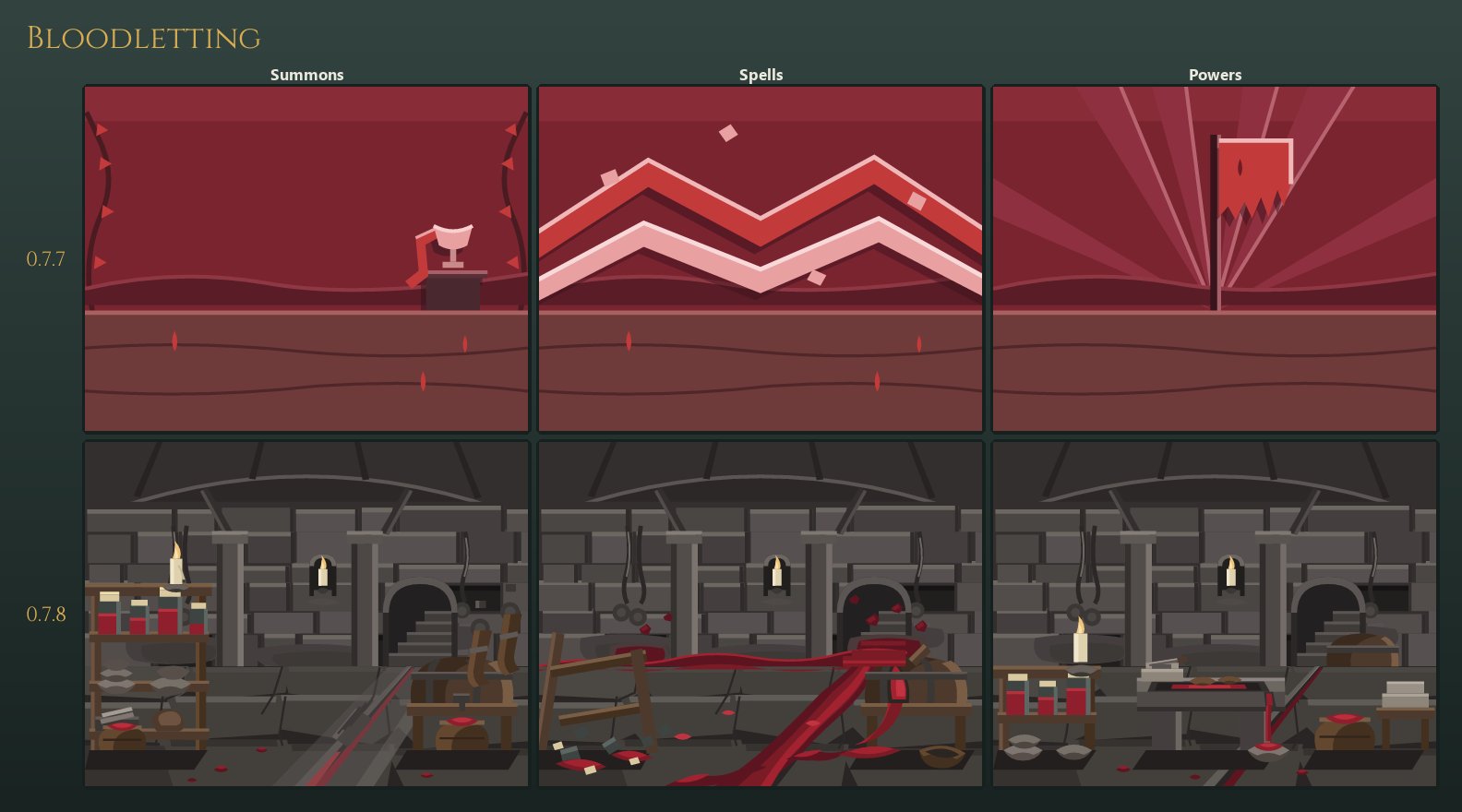
Bloodletting is the Letting Crypt, the vault under the count's hall where the tithe is taken and kept. The powers are the slab, the one stone the vault is built around. The spells are the crypt paid in full, the drain channel running over.
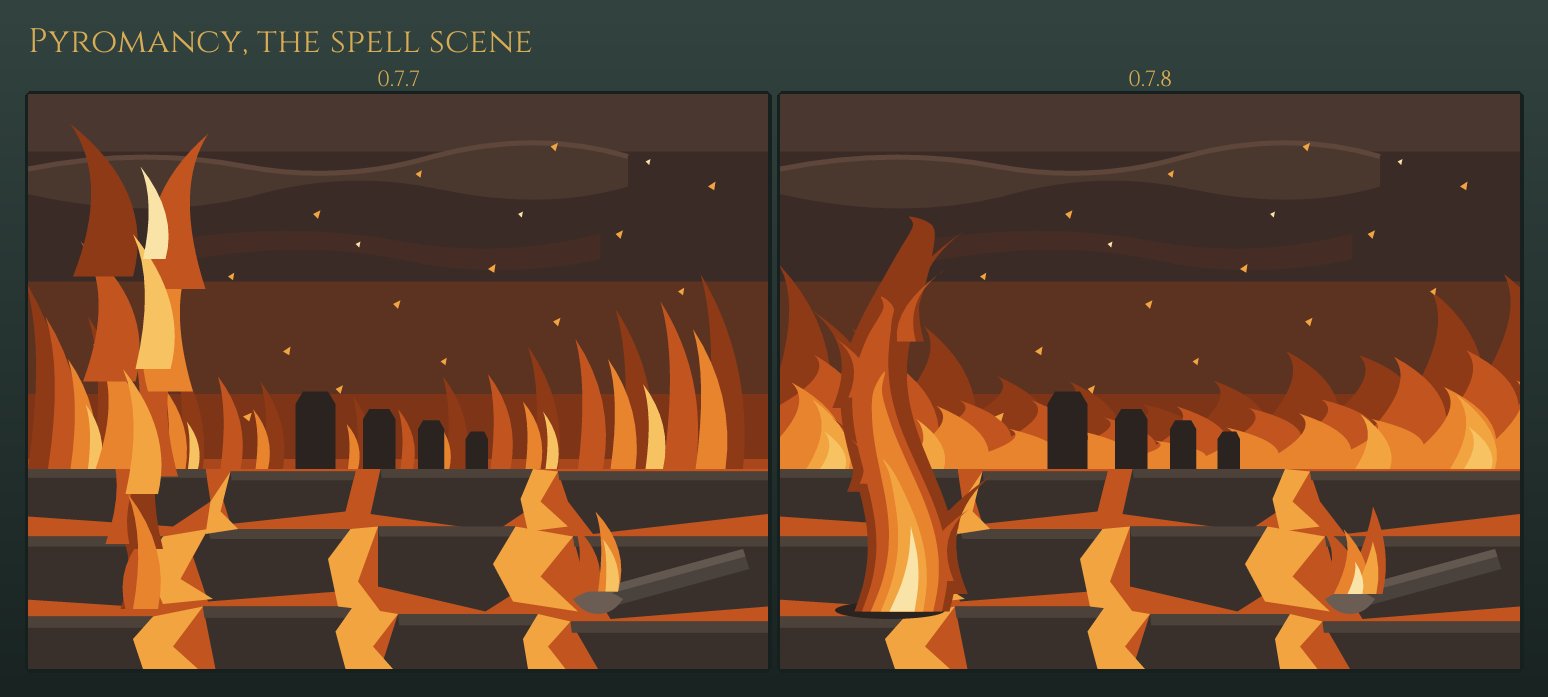
Pyromancy's Burning Ward was the first of these places and shipped last time, so it is not on a board above. Its spell scene was redrawn once more for this build: the fire is rooted and nested rather than stacked, the firewhirl is one column growing out of the yard, and the wall of flame is three ranks licking up behind the braziers instead of a row of separate tongues.
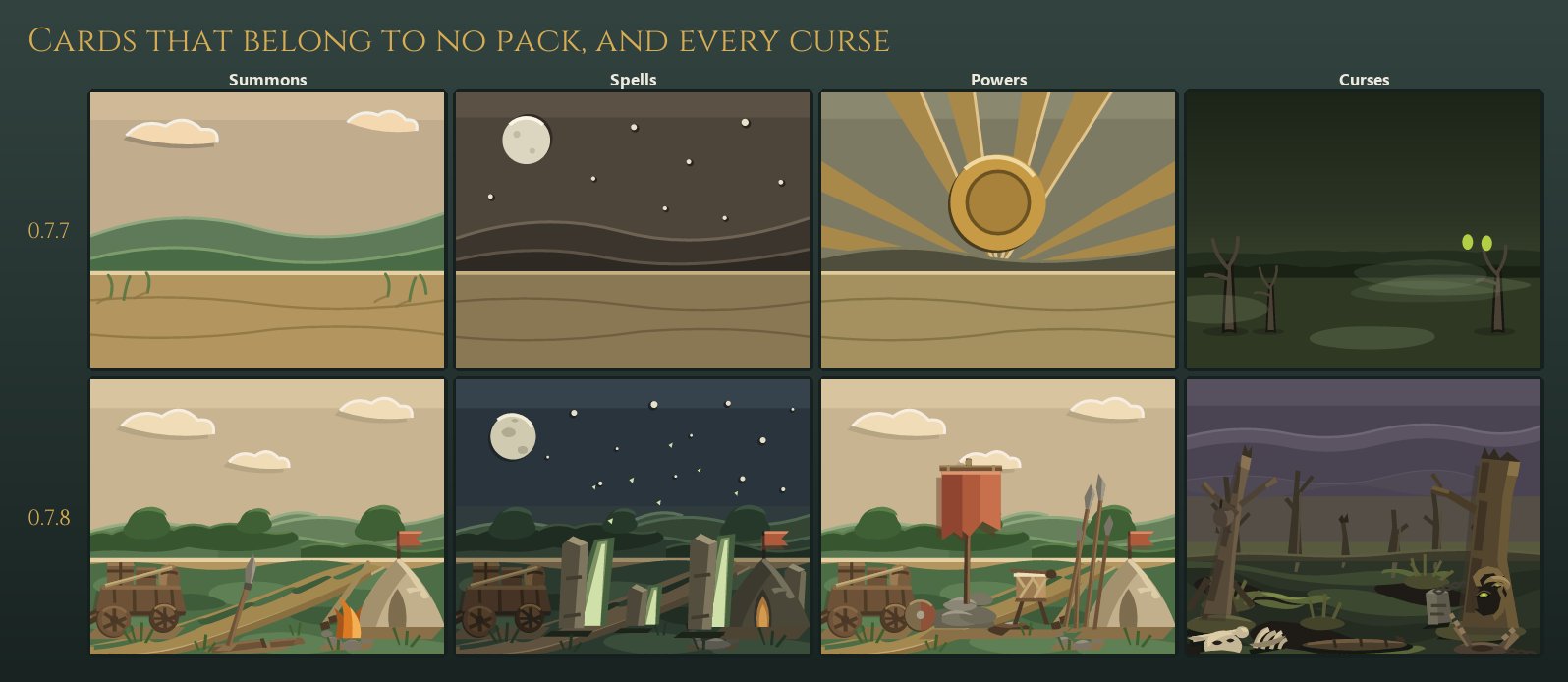
Three scenes are left for cards that belong to no pack and no warlord, and they used to be three unrelated drawings: a green hill, a night sky, a sunburst. They are one place now, the muster field, drawn three ways: by day for a summon, at night with the stones lit for a spell, and with the standard raised for a power. And every curse in the game stands in a bog, the sour one with the thing in it that is still watching.
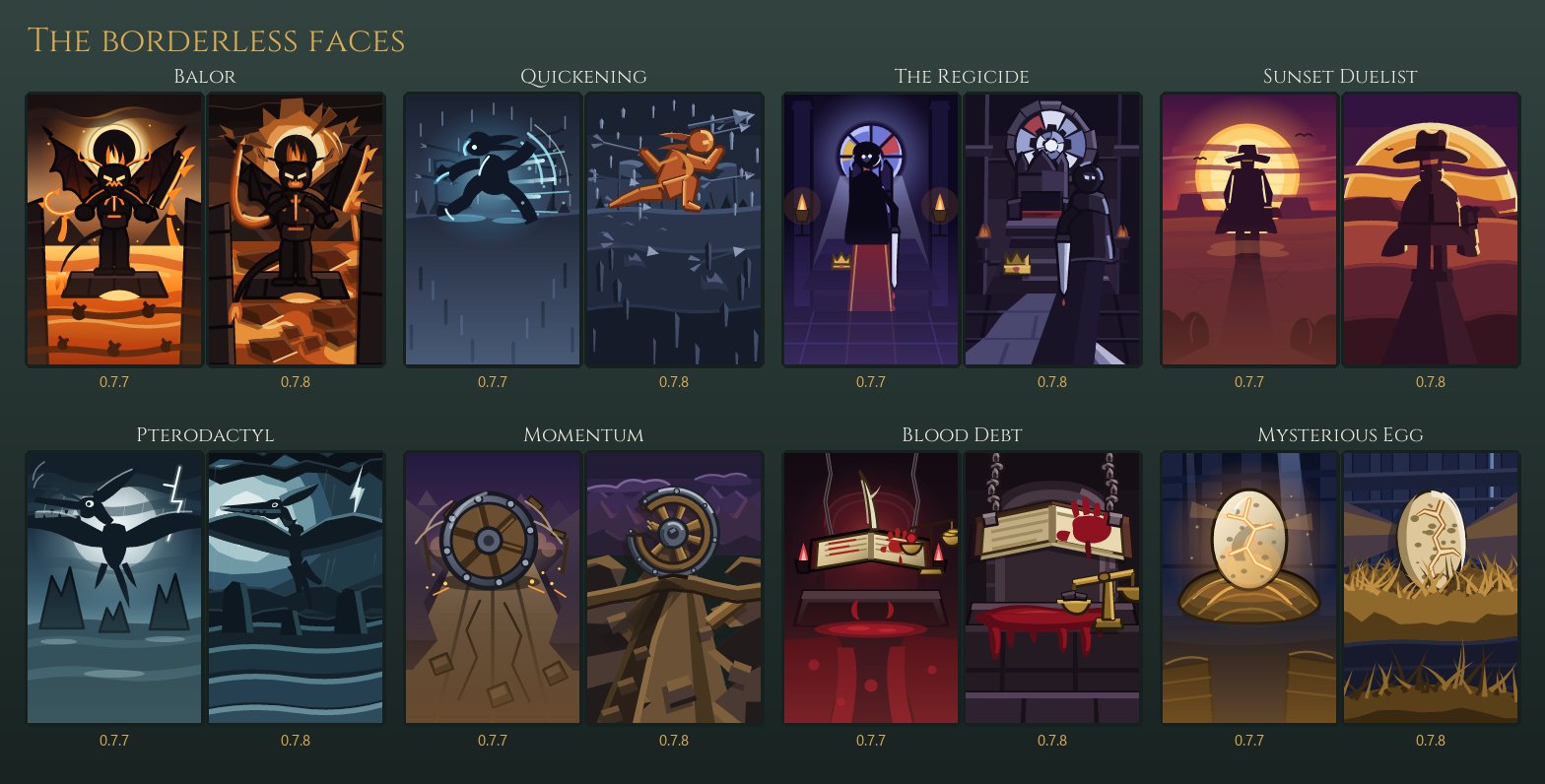
Fifteen cards have no frame: the painting is the face. Their cut-paper twins were drawn flat, and they are cut from paper now like everything else on the table. Balor stands between the two bright things in his picture. Quickening is a battlefield where everything has stopped in the air. The Regicide is the hall after the fact, the empty throne under the rose window and the crown on the step. The Sunset Duelist is cut flat against a sun the size of the sky. The Pterodactyl has stopped reading as a manta ray.
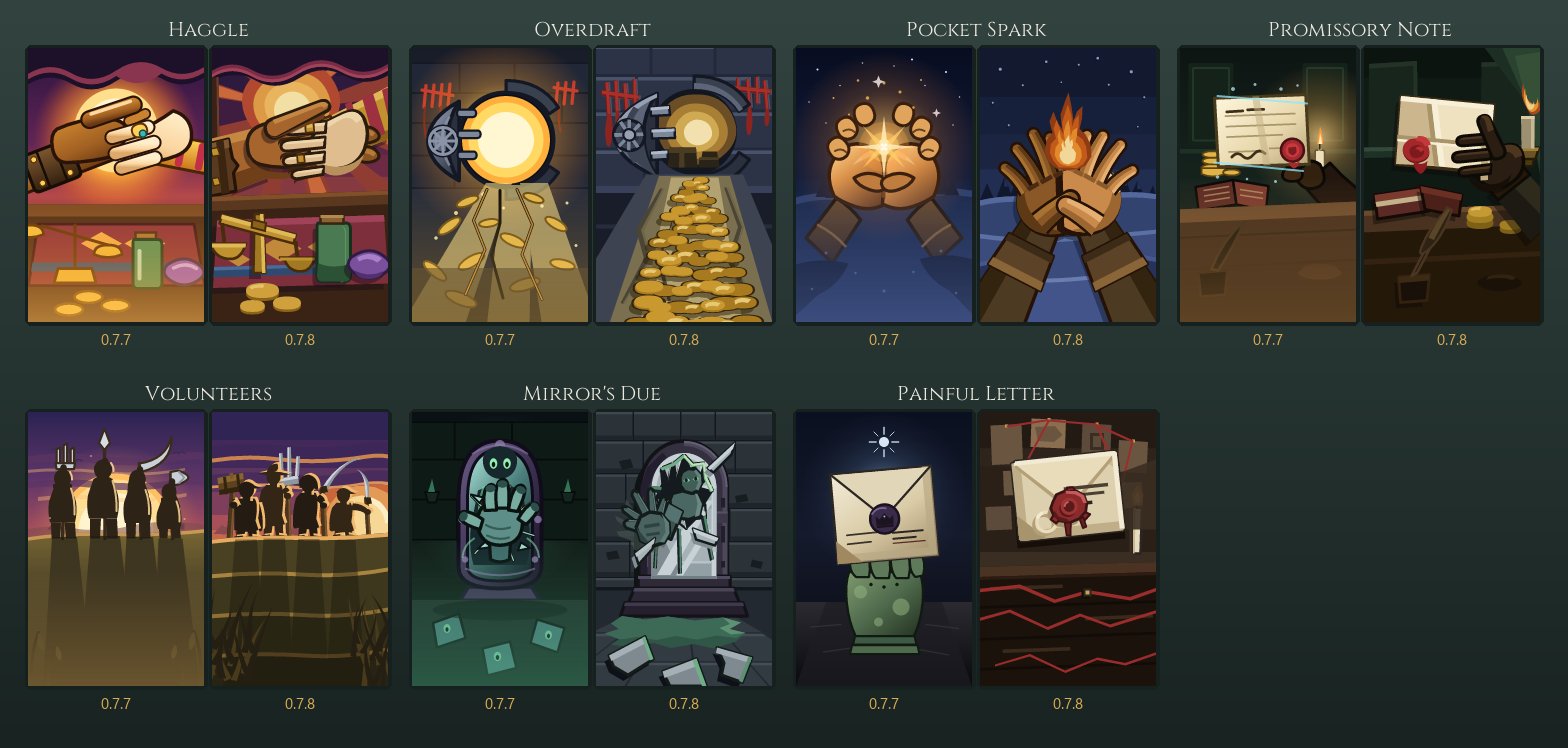
Haggle is the bargain being struck. Overdraft is the vault open with the light coming out of it faster than it went in. Pocket Spark is two cupped hands on a cold night around one live ember. The Promissory Note is a gloved hand out of the dark. The Volunteers are four farmhands on the ridge at first light with the tools they own. Mirror's Due is the thing in the glass that has stopped copying you, and the Painful Letter is the envelope from Motley Jack's road, still sealed, which you will meet below.
The back wall of the arena
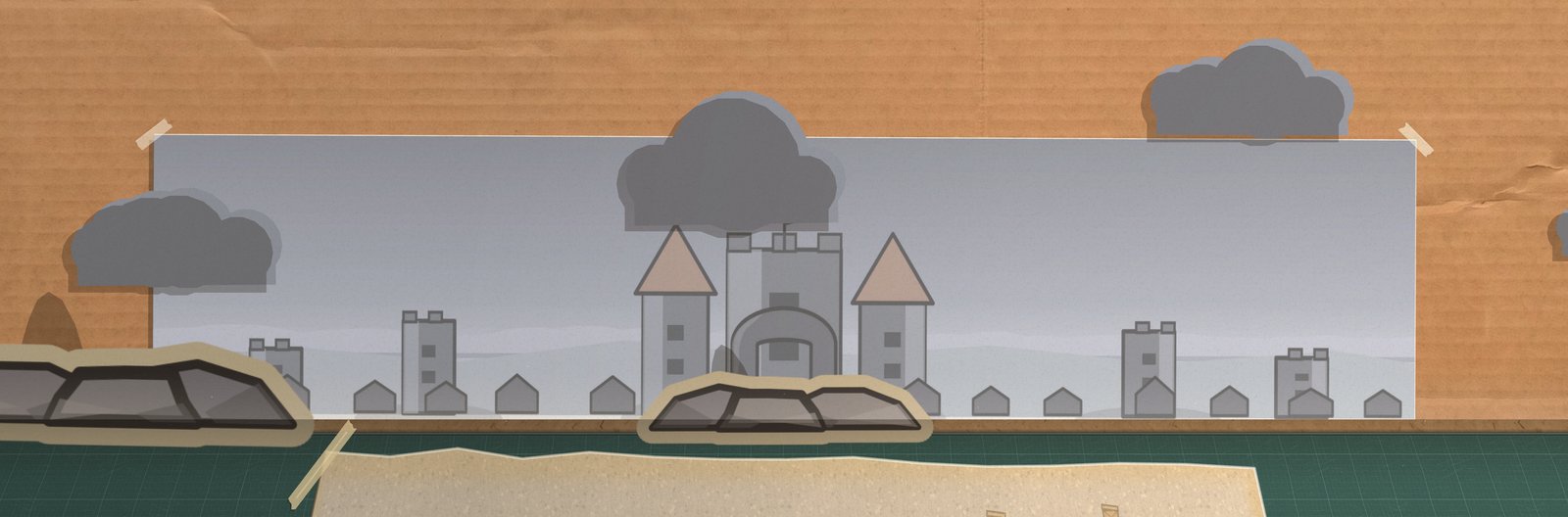
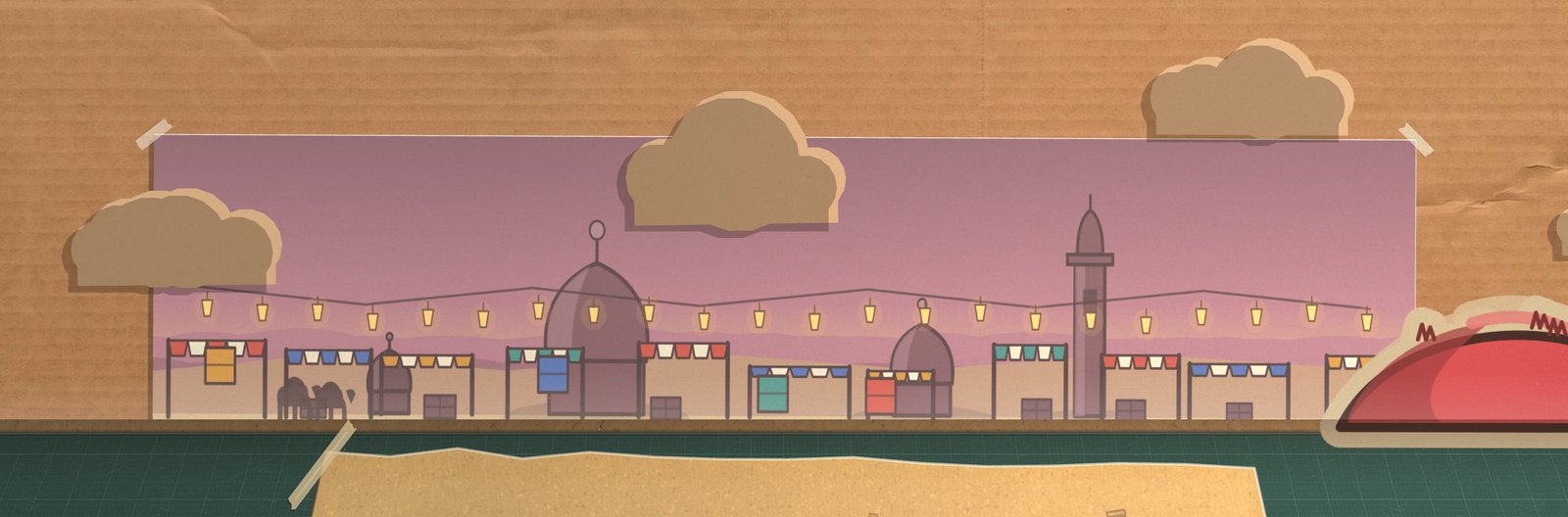
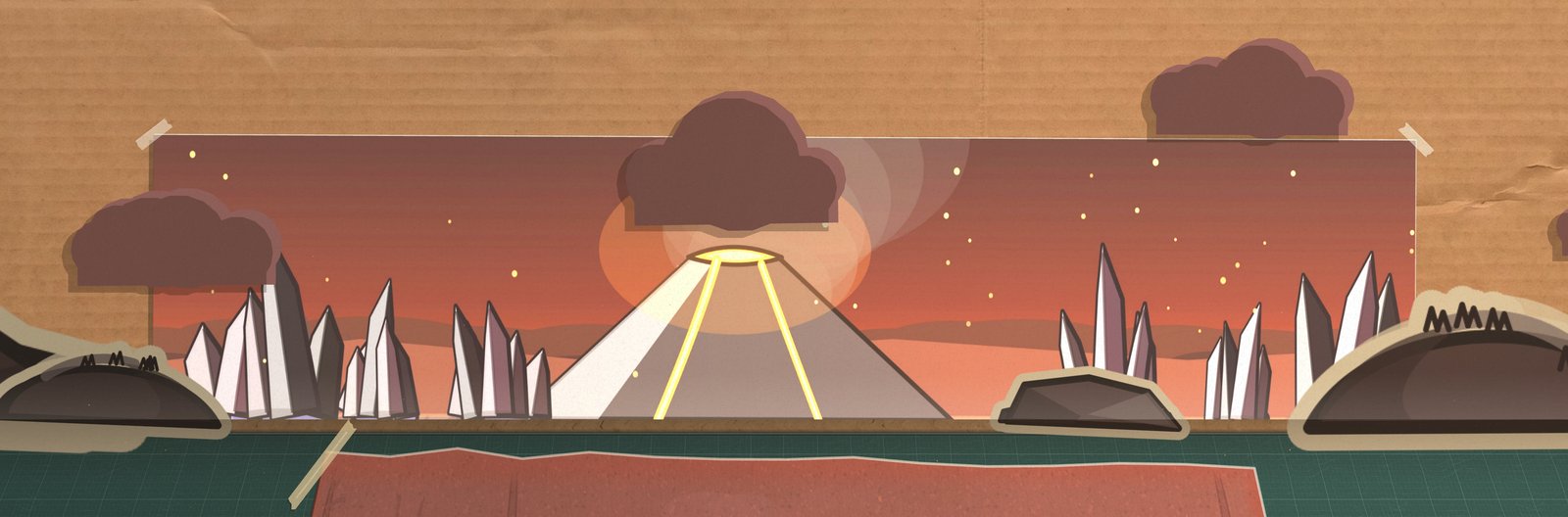
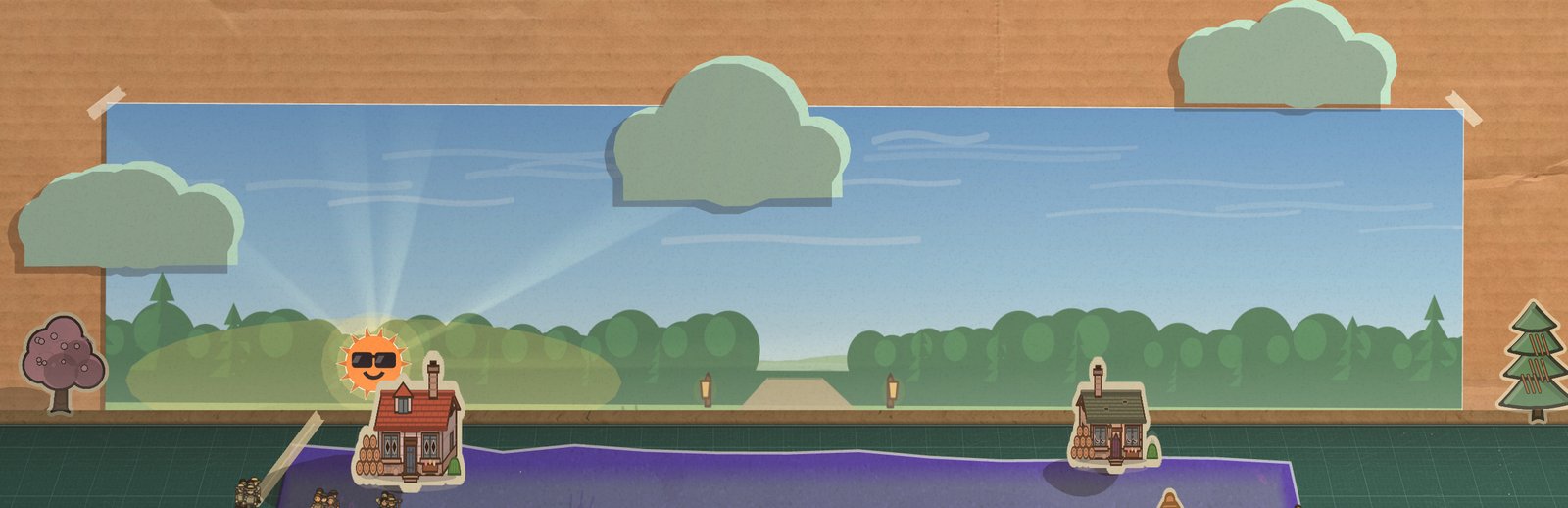
The arena is a box on a desk: a mat taped down, a rank of standing pieces, and a card taped to the back wall. Until now the card and the mat were one drawing cut in half at a fixed line, so the card was whatever happened to lie in the top band of a vista drawn for something else. They are two pieces now, each printed from a picture composed for its own job. Every lord's lair already was a picture, from 0.7.7. The theme stages, the fights that are not a lord's signature fight, were not: their card came out as sky, two soft ridge lines and a strip of ground, a blank sheet with a fold in it, behind every ordinary fight in that region. Twenty-nine of them got a back wall this build. Eight of those, old over new.
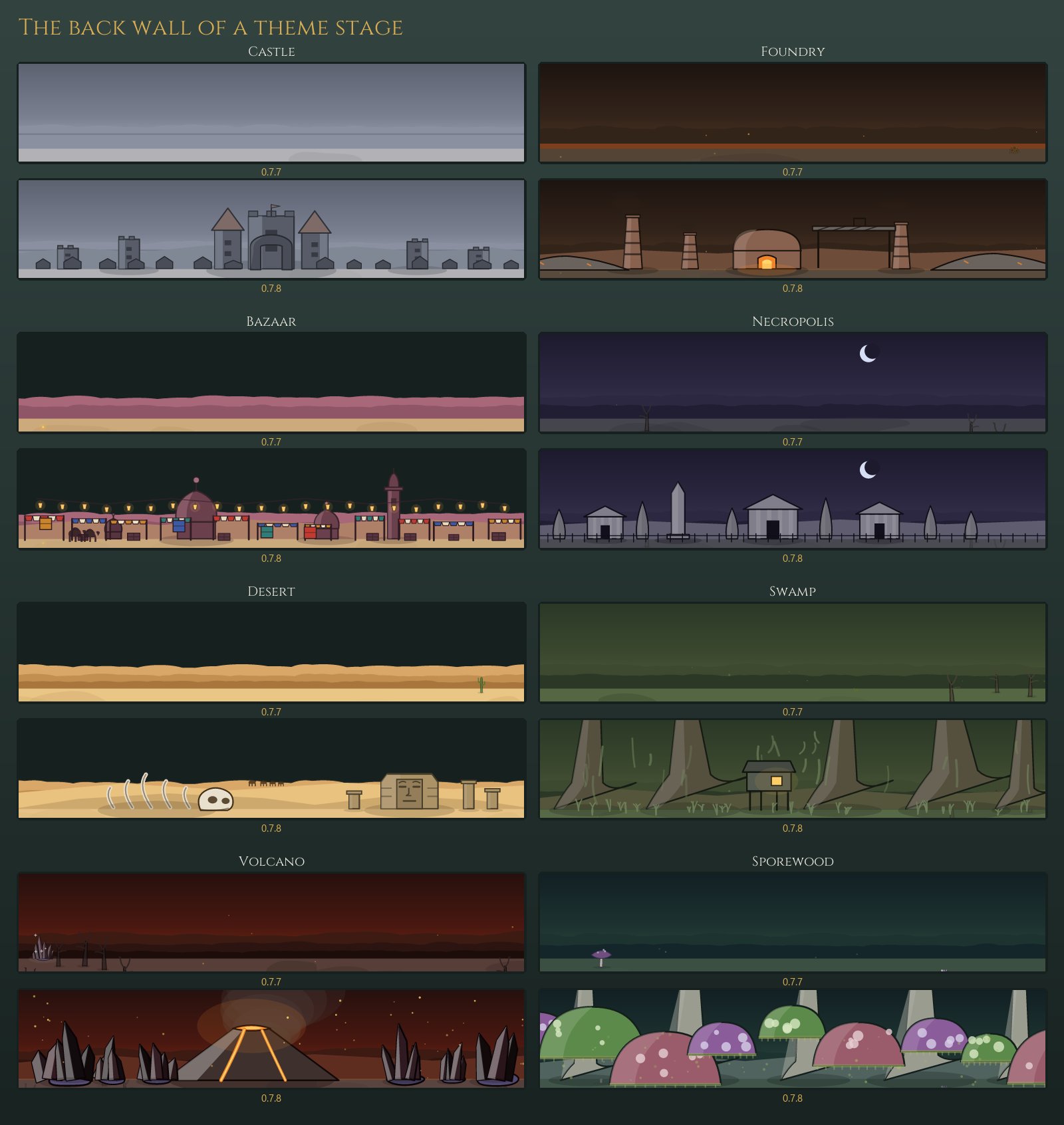
In the box, the Castle stage: the curtain wall given a gate to be the wall of, the keep behind it, the town's roofs in front, and the standing rank on the seam below.
The Bazaar: domes and a minaret over a staggered run of awnings, lantern lines strung the whole width of the card, and two loaded camels padding in on the left.
The Volcano: the cone, erupting, and everything else in the picture either lit by it or in the way.
Wally's card is a special case. His backdrop stays mostly sky on purpose, because the sky is the mechanic: the sun going down is the countdown, and the moon that takes over is drawn on the card. What his card gained is the wood, a treeline the length of the horizon with the lane out of the village left as a gap in it. It is painted rather than propped, so it takes the night re-dye with the rest of the plate and turns from a pleasant treeline into a wall of teeth on the same crossfade the village does.
Motley Jack
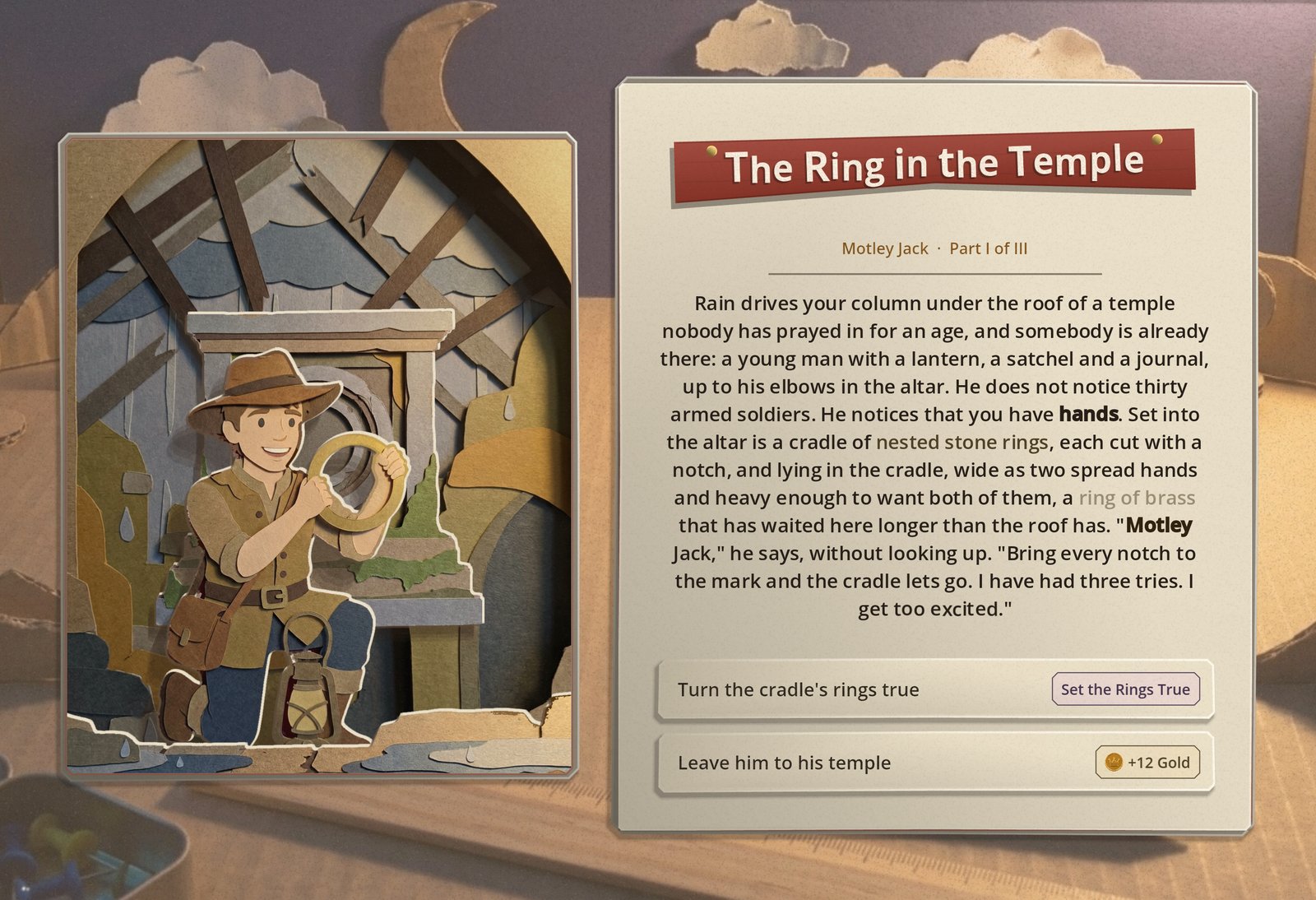
The Brass Pilgrim's three-part chain, the dead king and the words nobody could say, is gone. In its place is Motley Jack, an explorer you meet three times over twenty years. The first time he is young and in a temple, up to his elbows in the altar, and lying in a cradle of nested stone rings is the first of three rings of brass.
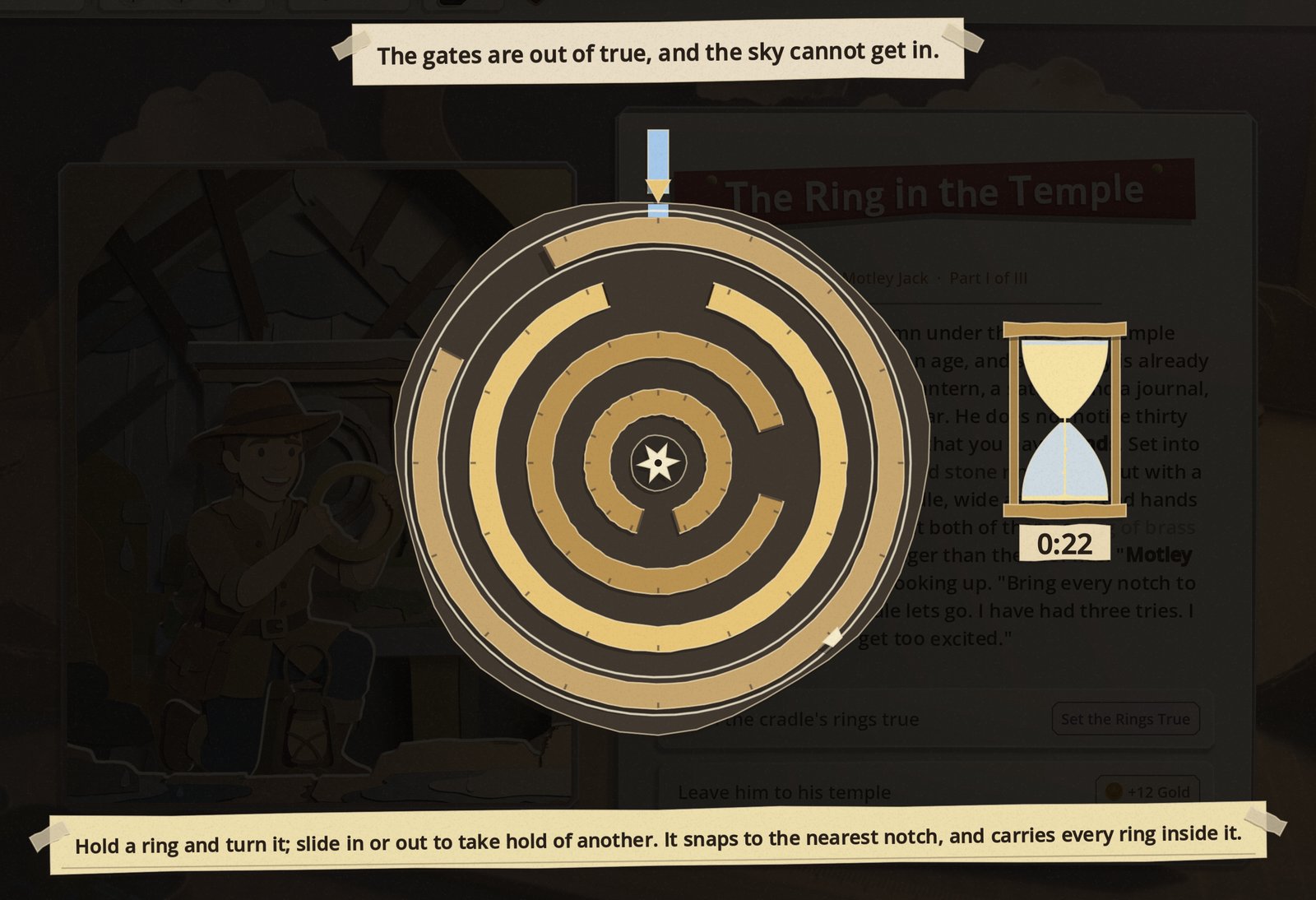
The cradle is the ring puzzle: four rings, each brought to its notch, and turning one carries every ring inside it. Win or lose, the page turns to his journal and you read what he thinks he is doing out here. Lose, and he prises the ring out anyway with a bar and most of the skin off one hand, and writes the last line left-handed.
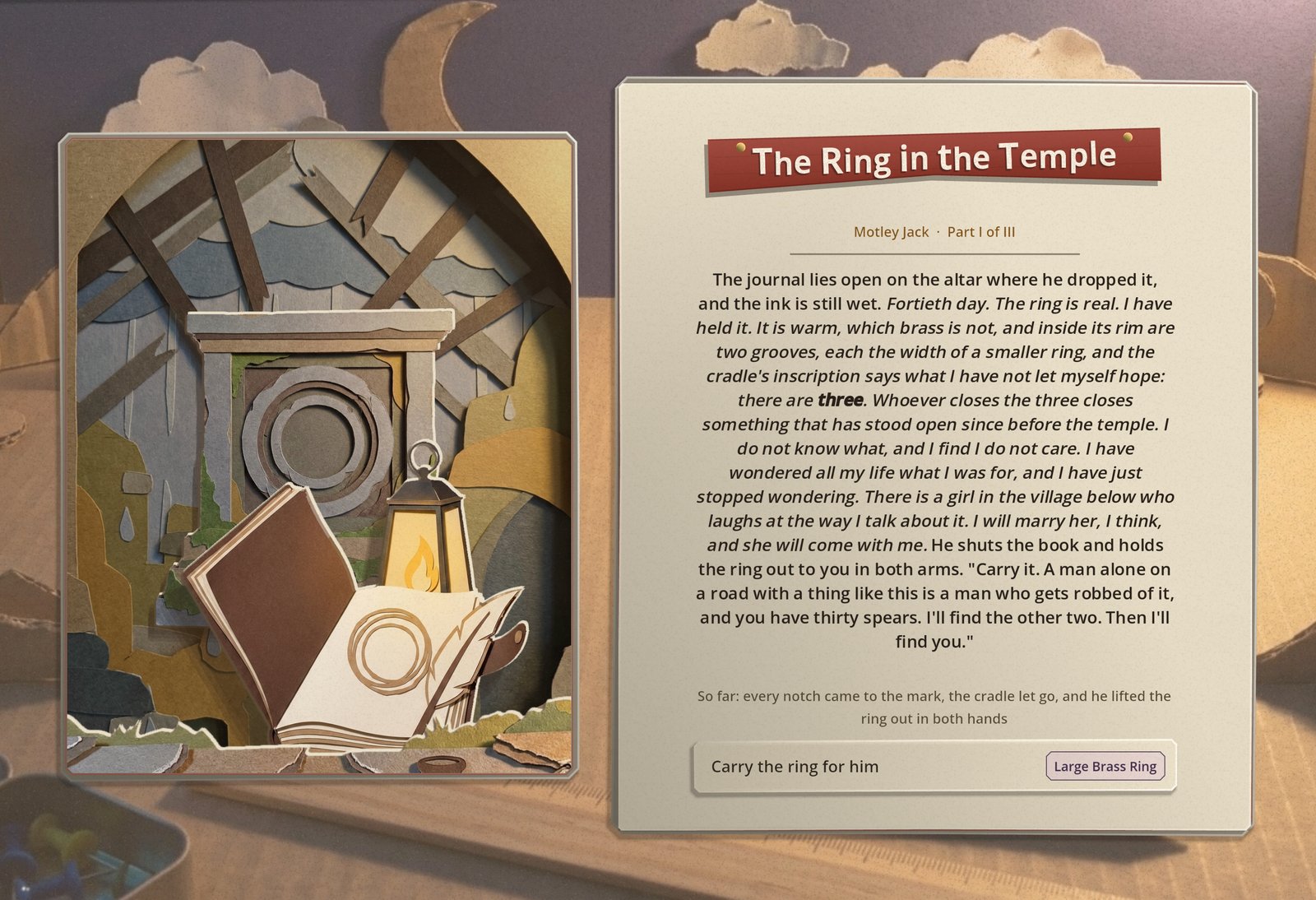
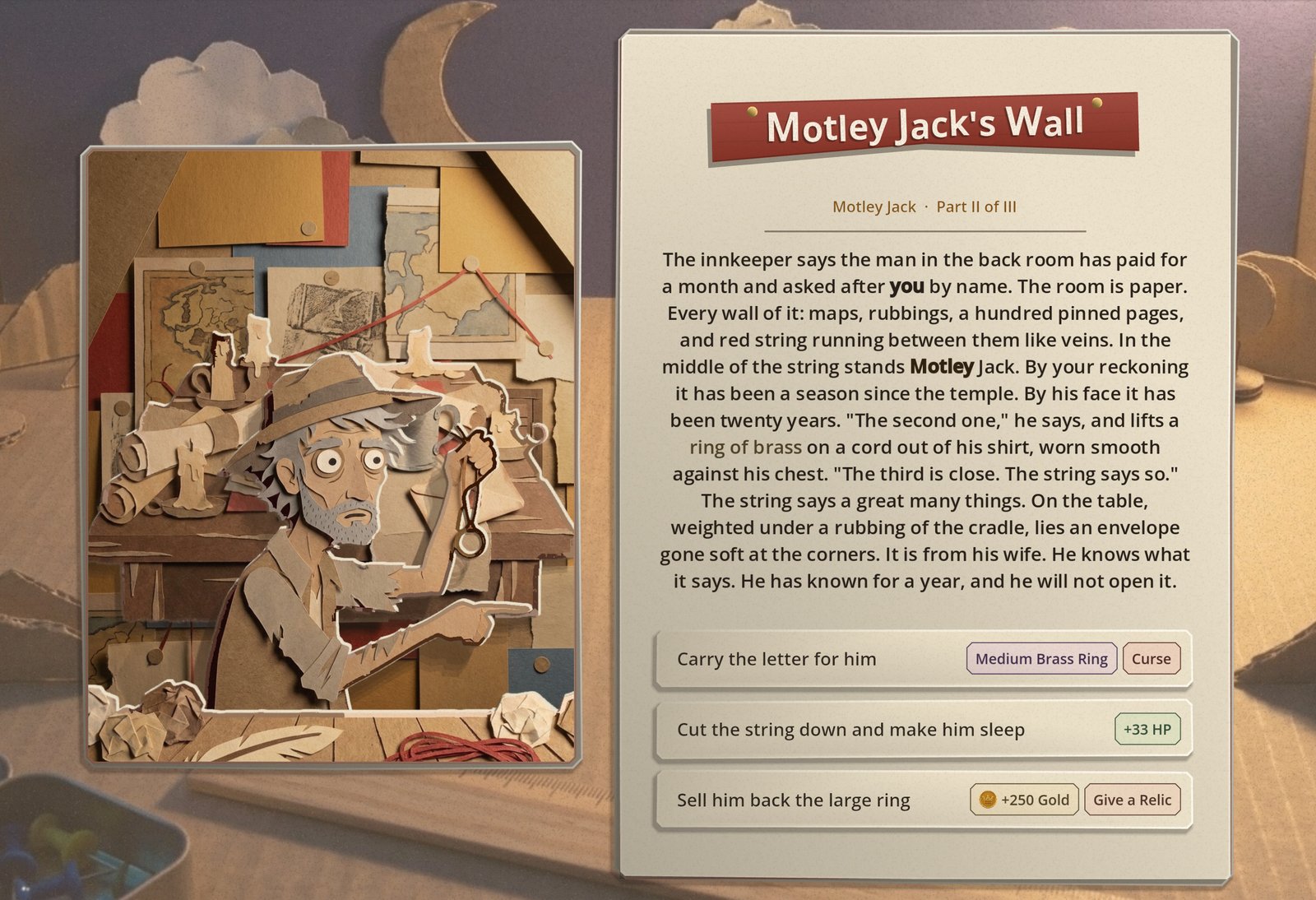
Carry the ring and it rides on your baggage cart wrapped in a blanket: a Large Brass Ring that blinds whatever hurts your commander, once a round. Twenty years later he is in a rented room full of red string, with the second ring on a cord round his neck and a letter from his wife that he cannot bring himself to open. The Medium Brass Ring comes with the letter, and the letter is a card: the Painful Letter, a curse in your deck until the road is walked to its end. You can also cut the string down and make him sleep, which heals you, or sell him back the large ring for more coin than he has.
The third time he is old, on the same altar, and the page turns to the letter itself. His wedding ring is inside it. Set the three rings together, the two brass ones you carried and the one out of the envelope, and the letter leaves your deck, both relics leave your belt, and the Completed Ring takes their place: one more energy every battle, and a shield on your unshielded units at the end of every round.
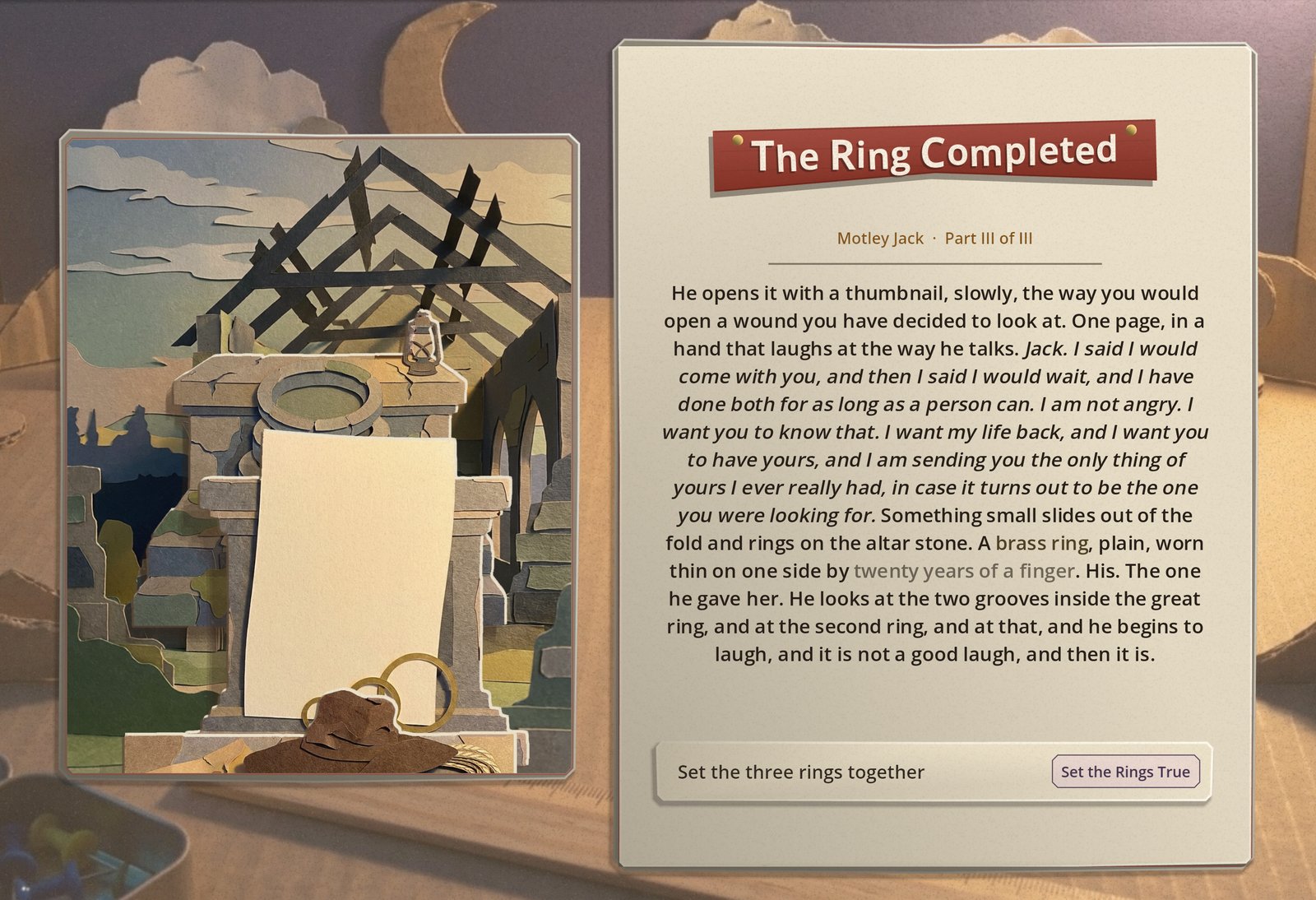
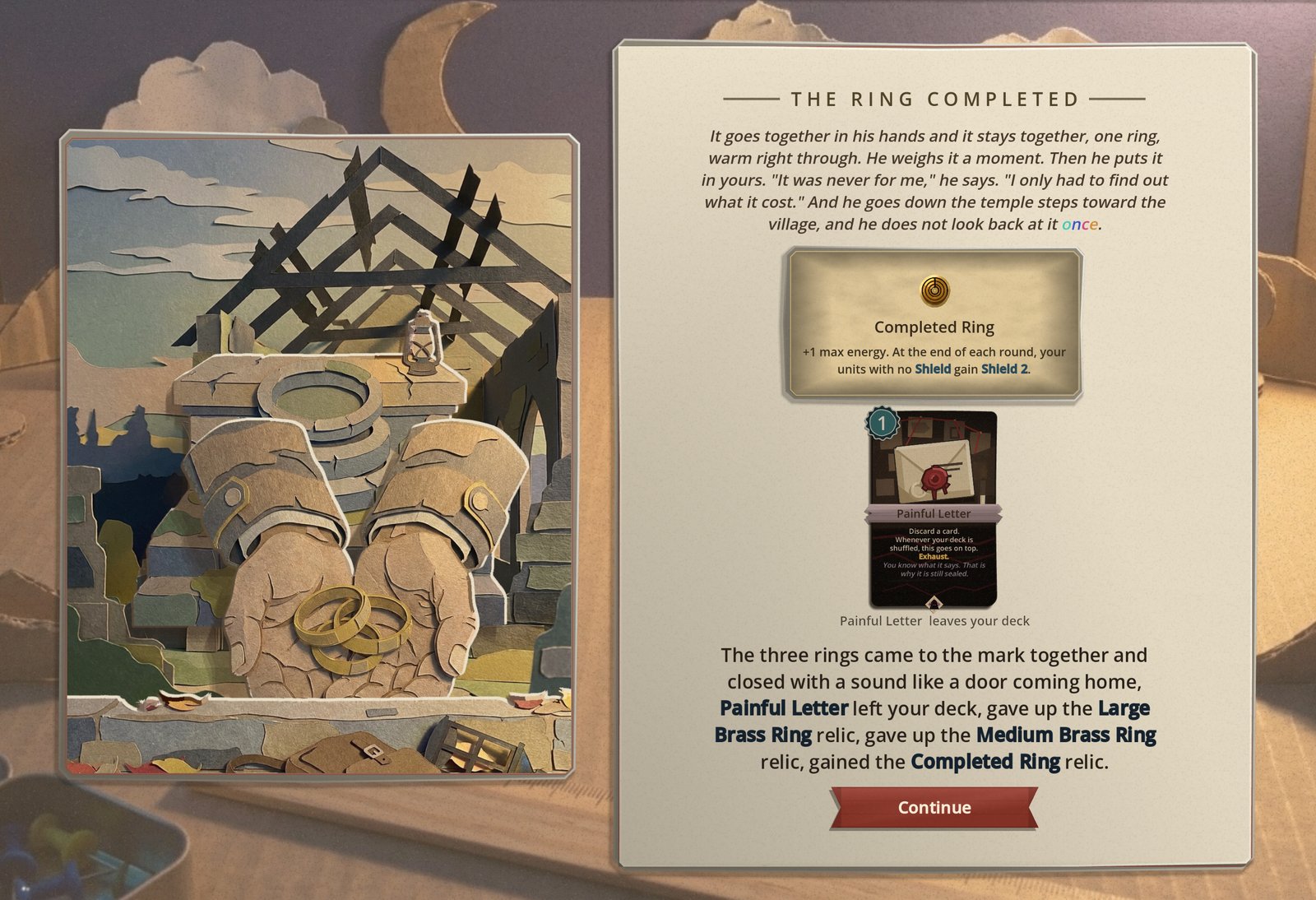
The achievement for seeing his road to its end is called Three of Three now.
The Sealed Grove
A new event, and a parody of a certain very large tabletop game whose name is not going to appear here. A druid circle has sealed its grove against a camp of horned refugees, and you arrive with a party that will be familiar in outline and a small wet thing behind one eye that hums. Every row on the page is a skill check, played for real: Persuasion to argue the refugees' case, Arcana to chant along with the rite, Deception to insist you are nobody worth the trouble.
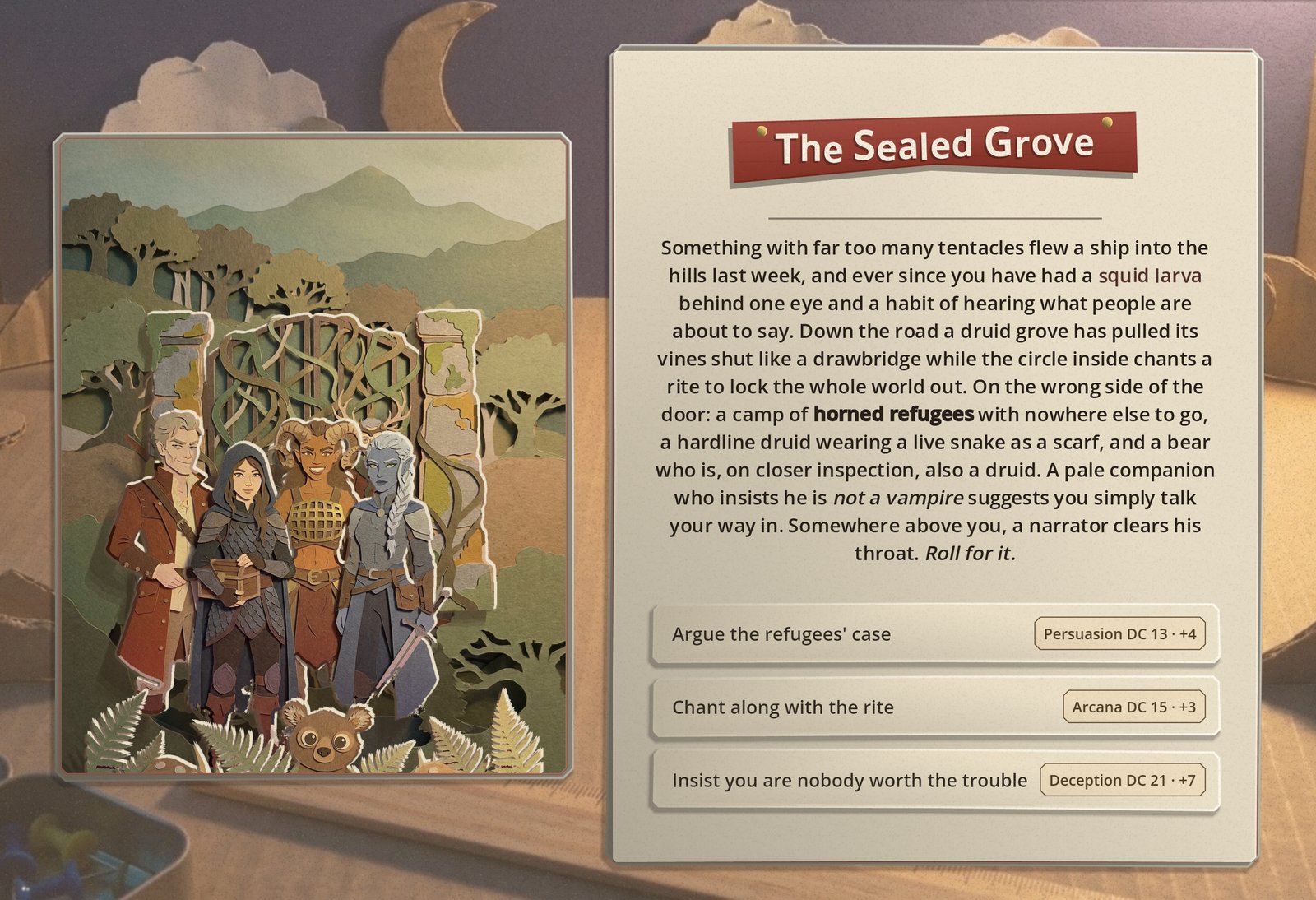
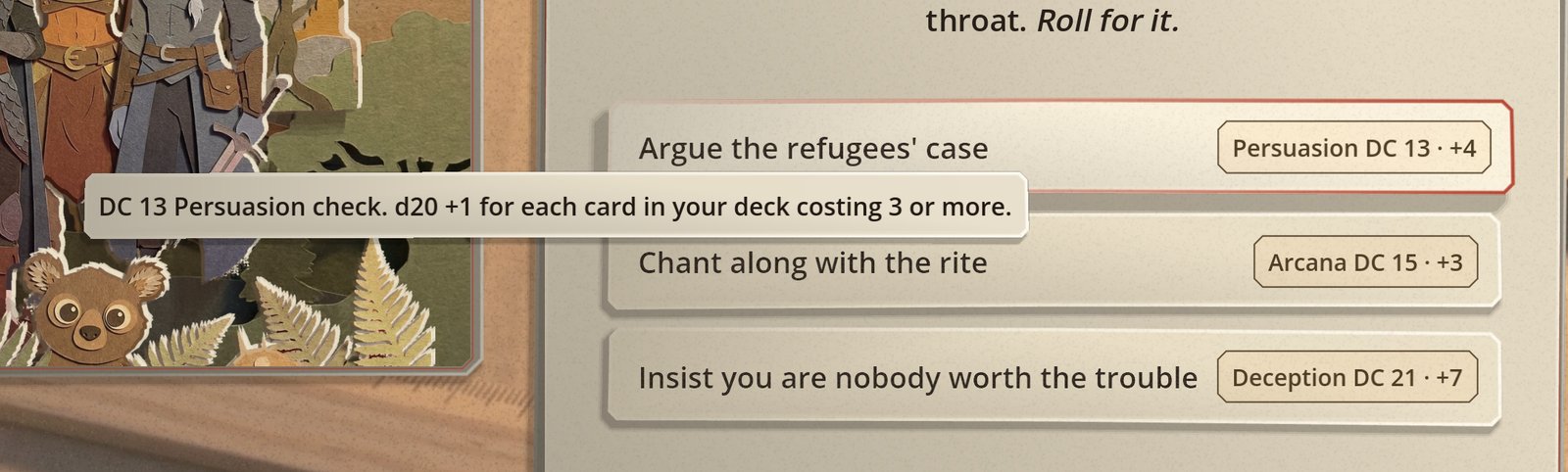
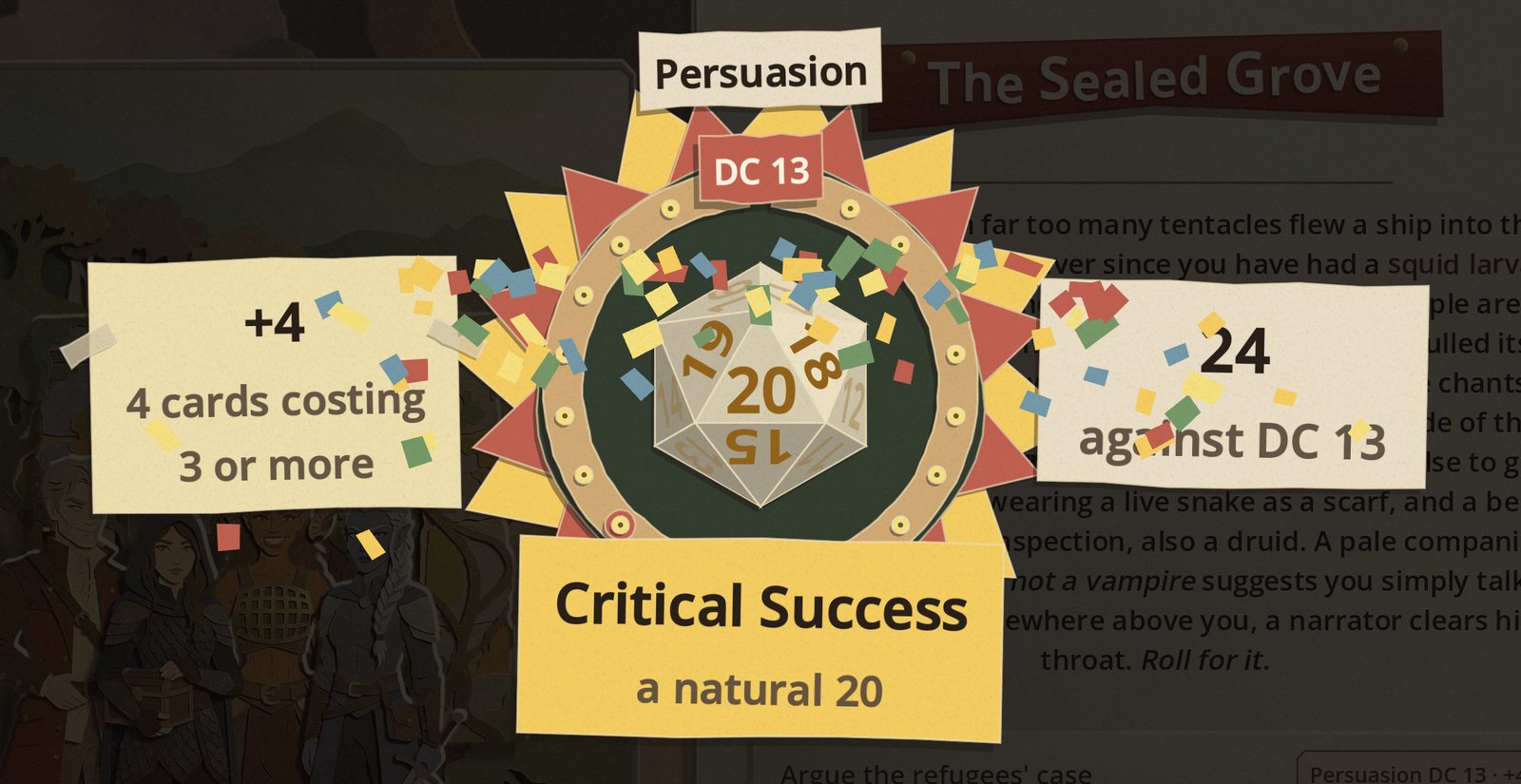
Hover a row and it tells you the terms of the check and nothing else: the mark to beat, the skill, and where the modifier comes from. The modifier is read off your deck. Persuasion gets one for every card in your deck that costs three or more. Arcana gets one for every spell. Deception gets one for every starter card you are still carrying, which is why its mark is 21: a plain deck is the whole disguise.
Then you throw the die, and it is a die: twenty faces of card, numbered so that opposite faces add to twenty-one, turned in three dimensions and tumbling across a dark dial until it comes to rest with one face up. Nothing is rolled in advance for you to watch a picture of. The face is decided at the throw and the tumble is turned to land on it.
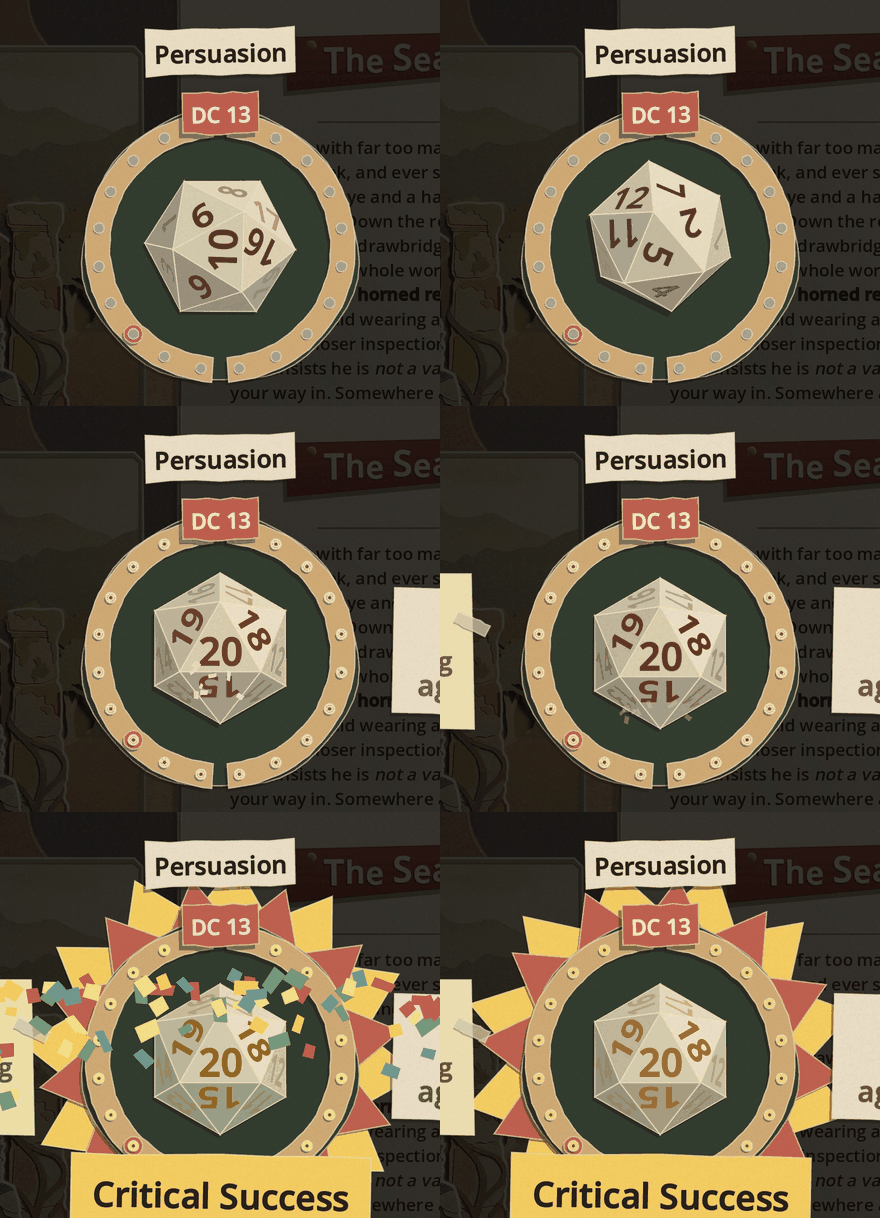
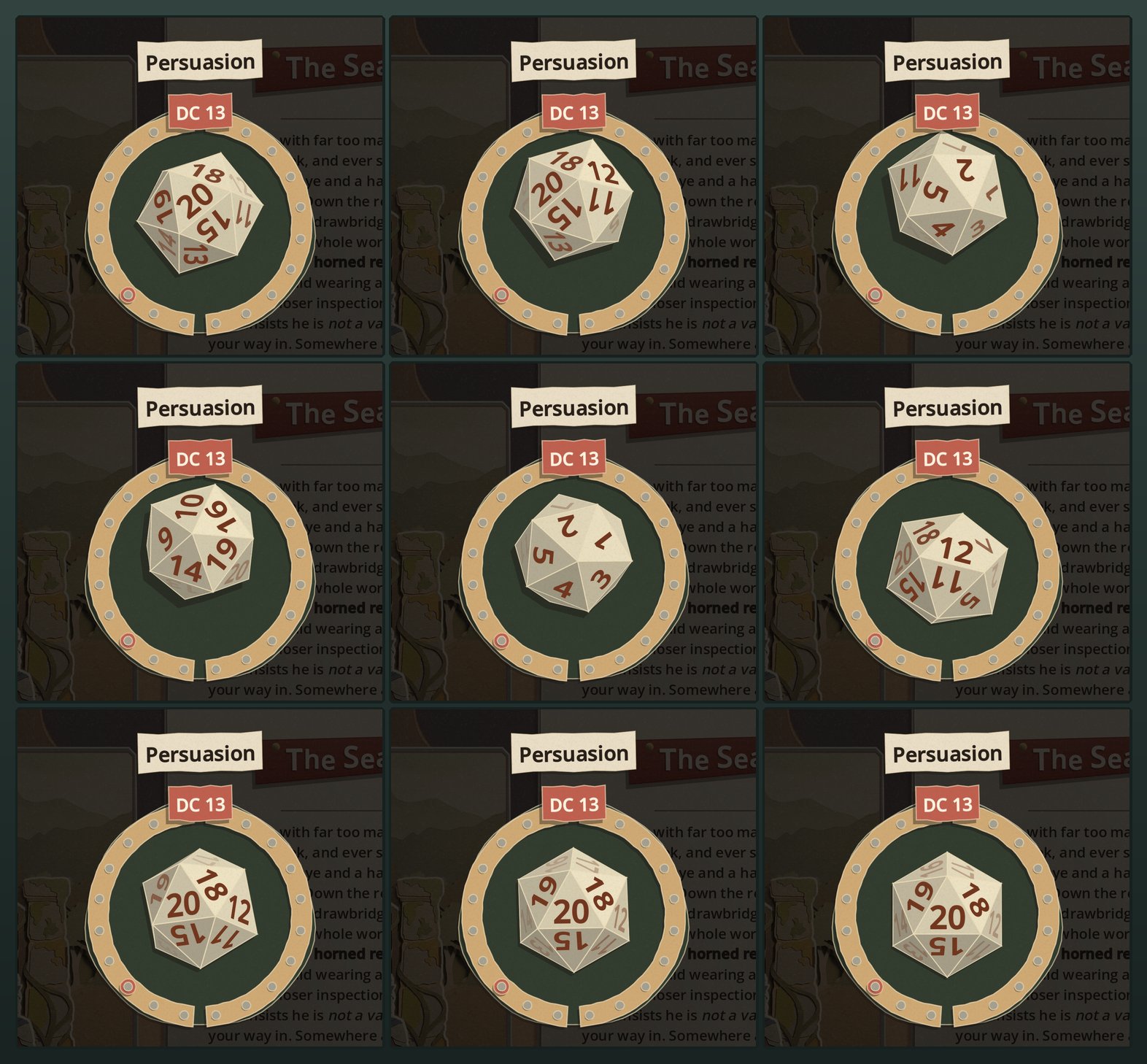
When it lands, the modifier slaps down on a manila card to the left of the dial, the total counts up on a file card to the right while the pips light round the ring, and a strip lands the verdict. A natural 20 carries the roll whatever the mark, with a star and a shower of scraps, and opens a third branch on each row that a plain success does not. A natural 1 is a critical failure, and the page says so.
Nine endings, three per row, and each one turns to its own page with its own picture. Argue well and the horned camp passes a hat; argue badly and the snake casts the deciding vote in your ankle; roll the 20 and the archdruid roars the motion carried and hands you something off the altar so nobody else can steal it. Chant well and the circle teaches you a verse, which is a card; crack, and the thing behind your eye learns a word, which is a curse. Convince the gate you are nobody and it opens; get seen through and a horned girl with no shame at all relieves you of your purse while the guards argue over whether a squid counts as a weapon.
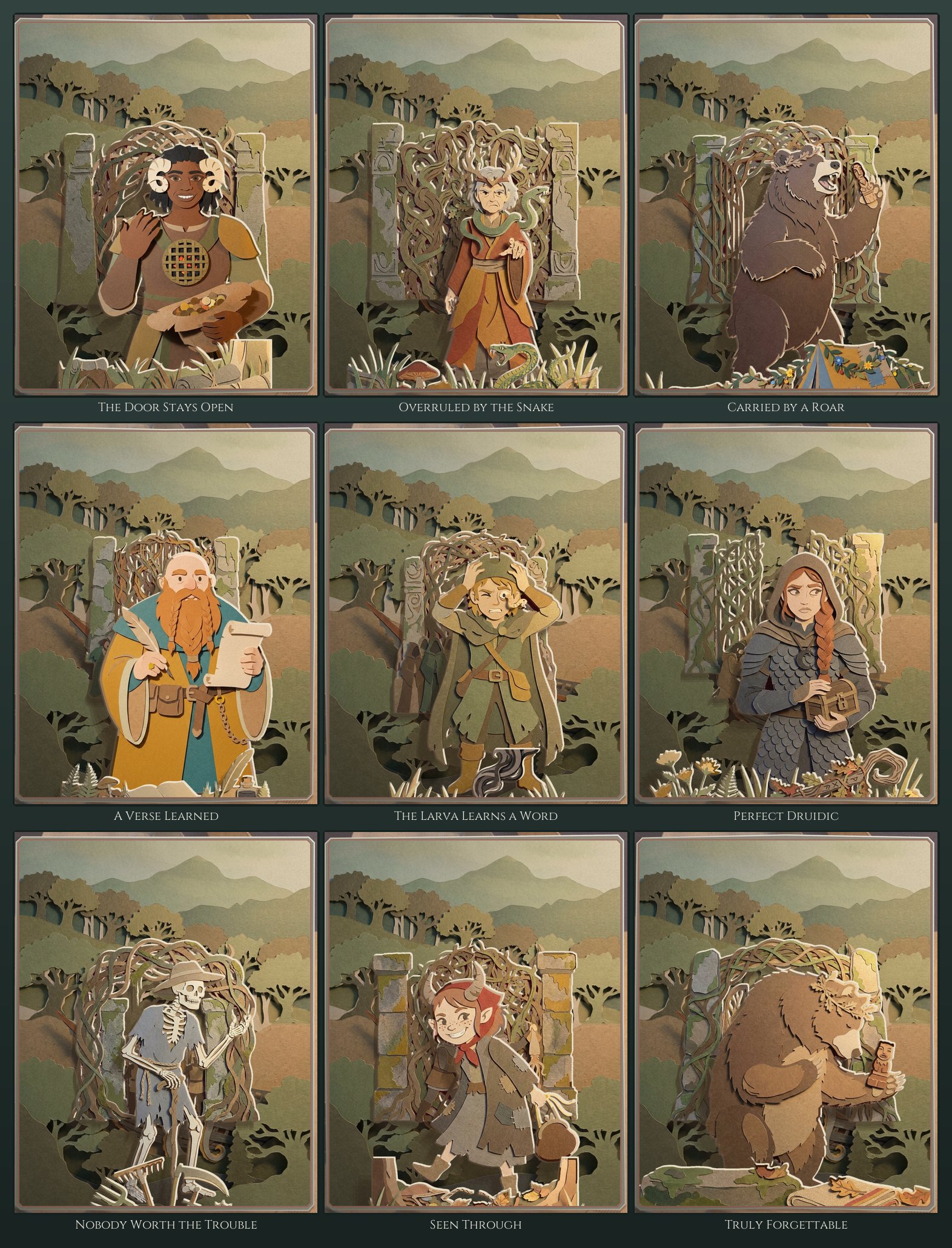
The party is inspired by its models and drawn from none of them, which is the only way a parody like this gets to stay in the game.
This post went out to players on itch.io on 10 September 2026, and is kept here. Comments and questions are read on either of those, or through the quill in game.