
Every commander gets a stage of their own

This one is mostly about looking at things. Forty-two enemy commanders, forty-two hand-drawn arenas, and a browser build that finally runs like it should.
The arenas
Every enemy commander now fights on a stage built for them — backdrop, mat, and the standing pieces in between. Thirty-nine were redrawn for this release; the other three landed just before it.
The Frozen Harbour has real longships and a red lighthouse, with a fish frozen in its block. Grave Tide's great wreck reads as a ship now: the ribs have a keel and the anchor is shaped like an anchor. The Bone Throne is actually a throne — ribs, vertebrae, a crowned skull. The Razed Village burns properly, house-shaped shells and a church skeleton over an ash-dressed mat. The Luggage Graveyard got a monument: one colossal open steamer trunk.
A few of them move. The Elder Treant's ground grows a tree from seed to crown and back to seed, and the loop closes on itself — the last frame is the first frame, the same seed lying in the same spot. Verdy B. Queen's hive grows a course taller and wider for every three of her swarm still standing, so you can read how the fight is going off the wall behind her. Wind crosses her meadow as a travelling swell rather than every blade nodding on its own timer.
Wally's moon rises through clear sky now, too. It used to set behind a tree.
Icons
Four hundred and eighty-five icons were redrawn.
The old set leaned on symbols where it should have drawn the thing: motion dashes for movement speed, a flask and some plus signs for a growth serum, circular arrows for a shuffle. They are a boot, a syringe and a die now.
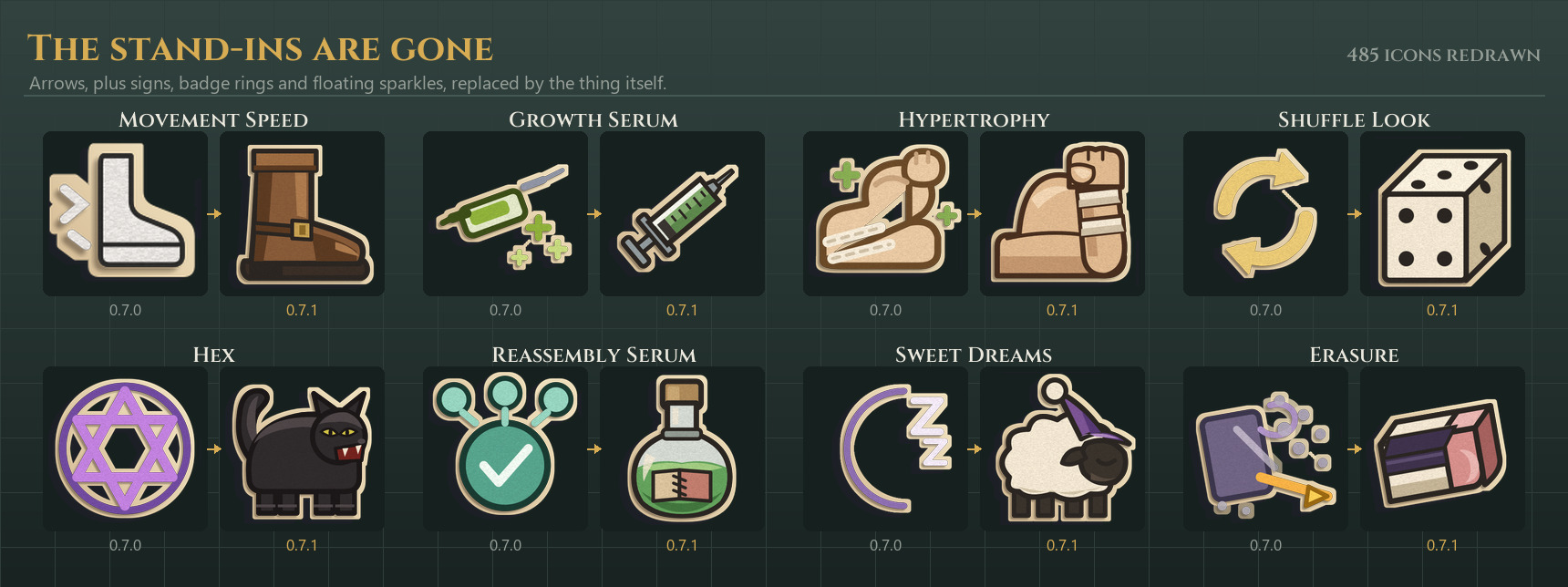
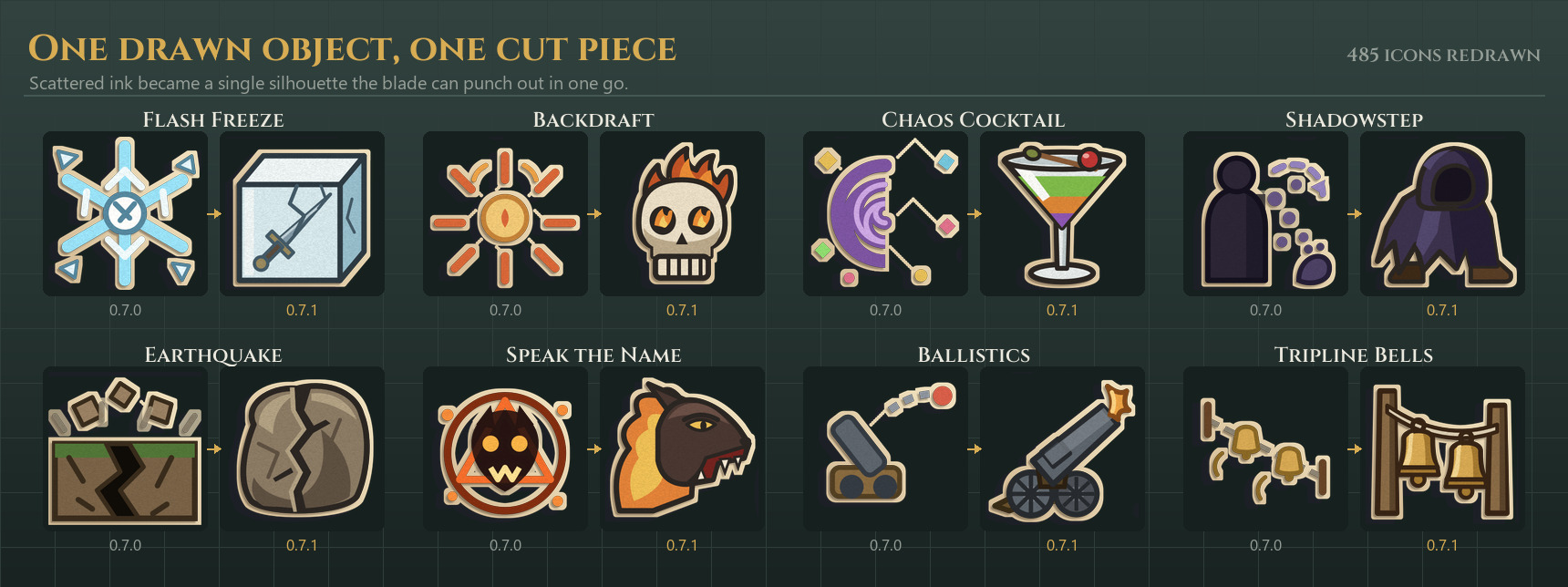
Three hundred and fifty-four of them used to be several disconnected islands of ink. None are now — every icon is a single silhouette that a blade could punch out in one piece, which is the whole idea.
The browser and the phone
The web build was rough, and the reason turned out not to be what anyone assumed.
The frame is bound by how many things are drawn, not how many pixels they cover. Hiding the painted layers on each piece's cardboard stand saves about a quarter of the frame; shrinking those same layers to a fiftieth of their size saves nothing at all. The stands were costing more than the soldiers standing on them.
So: the die-cut edge now walks a number of steps matched to how big the cut actually is on screen — a small standee no longer pays for a blade it never shows — and the browser and Android builds stand their lights down, drop a full-screen pass, and stop drawing at twice the resolution on high-density displays. Icons ship with mipmaps where they are drawn far smaller than they were authored, which makes them both sharper and lighter in memory.
Wally has a song
Every boss had a theme except one. Wally's arrives with the fight now — sunny radio pop that tears into something with teeth at each moonrise and then pulls itself back together, which is the honest summary of Wally.
It is on the jukebox with everything else: thepaulbooth.com/cardboard-conquest-jukebox
The Instar line
Instar I through VIII was eight variations on a green crab. It is a real progression now: one new feature per molt, in an order that means something — the outsized right claw, then the shell plates, then the matching left, the tail, the head, the blade, and finally the crown. The keel laid down at the third molt is what splits open at the eighth.
The flavour text reads as one story across the eight cards, counted in the shells it leaves behind. Instar VIII gets the pop-out cutout, because by then it has earned it.
Those cards also speak the other nine languages now. Instar II through VIII had always shipped in English no matter what you had selected — the translation pass never followed a card into what it hatches into. Thirteen links like that were found and fixed, so summoned units, death-spawns, trap pieces and polymorph targets all carry their names and flavour into every language.
Fixes
- Every sheet in the cardboard stack shows its cut edge again. A ply could lose its corrugation entirely and read as a flat coloured shape, and the strips could break into offset segments around curves. Two of six arenas were affected before the fix.
- A unit that grows now stands on a stand that grew with it. Growth-fed bodies were overhanging discs at about two-thirds the size they should have been.
- A card previewing another card draws its pop-out properly. Anything shown as a referenced card — what a unit hatches into, what a trap springs, what a spell summons — drew its art shrunk inside the frame instead of cut out and standing off it. The controller focus ring traces the cutout now.
- Wally's transformation swaps cleanly. Both names could show at once, with the new one adrift beside his head.
- The telegraph column and the recent-plays record now follow their commander instead of sitting where the board says they should — on some stages that was a third of a screen out for the whole fight.
- Arc Coil zaps for 3. Cover of Night prints its keyword rather than its rulebook. Silvertongue is a snake again.
This post went out to players on Steam and itch.io on 28 August 2026, and is kept here. Comments and questions are read on either of those, or through the quill in game.